



Lift Tables in Manufacturing: The Essential Guide to Mobile vs. Stationary Models
Lift Tables in Manufacturing: The Essential Guide to Mobile vs. Stationary Models
Choosing between a mobile lift table and a stationary model isn’t just about the price tag—it’s about preventing a 20% drop in assembly line efficiency and protecting your workforce from chronic back strain. Whether you’re managing a 4,000kg load or a fast-paced sorting hub, the wrong choice can lead to costly downtime.
Today’s production processes move at a quicker pace and present greater challenges than before, which places considerable bodily strain on those performing the major lifts. Experienced supervisors recognize that preventing staff from leaning down excessively or extending too much offers the simplest method to avoid exhaustion and accidents. Everything centers on ergonomic design, adjusting the task to an appropriate level so that the user maintains a balanced and relaxed posture.
I. Introduction to Modern Lifting Solutions in Manufacturing
Qingdao YILU LIFT Intelligent Equipment has invested more than 20 years in determining precisely how to assemble these devices so that they withstand demanding conditions effectively. Located in Qingdao, China, the manufacturing site emphasizes creating tools that value sturdiness and practical operation above eye-catching additions. Regardless of whether a plant handles large-scale assembly or targeted stacking tasks, deciding between a fixed and a portable version determines how well that area functions over extended periods.
And in addition, fixed lift tables serve as the primary forces on assembly lines. These are the units you fasten to the ground or install in a recess since they stay in position permanently. They emphasize firmness and are engineered to manage loads that would overwhelm a portable model. Within a lasting configuration, such as a categorization point or the conclusion of a conveyor system, a fixed lift delivers a degree of accuracy and strength that’s difficult to surpass. Furthermore, because they typically connect straight to the facility’s electrical supply, they operate rises and descents continuously throughout the day without requiring any battery renewal.
II. Stationary Lift Tables: Power and Precision for Permanent Workstations
Among the most dependable choices for these substantial-load activities is the 1–4 Ton Standard Lift Platform from YILU LIFT. This version excels particularly in external building projects or intensive factory arrangements where a base that remains steady is essential. It employs a sturdy scissor structure to support up to 4,000kg, positioning it as a preferred option for facilities that process large initial materials or substantial equipment components. Consequently, it forms the core support of a work area, offering the handler a firm top that holds even under maximum weight.
Although fixed lifts provide excellent reliability, they miss the adaptable nature that numerous contemporary storage facilities require. Portable lift tables address this shortfall. Consider them as a combination of a trolley and a working table. They enable an employee to grasp a bulky component from one section, roll it through the facility, and subsequently elevate it to the precise level required for the following individual to handle. This adaptability proves invaluable in environments that frequently alter their ground arrangements or lack room for specialized carriers in each section.
III. Mobile Lift Tables: Flexibility and Versatility for Dynamic Environments
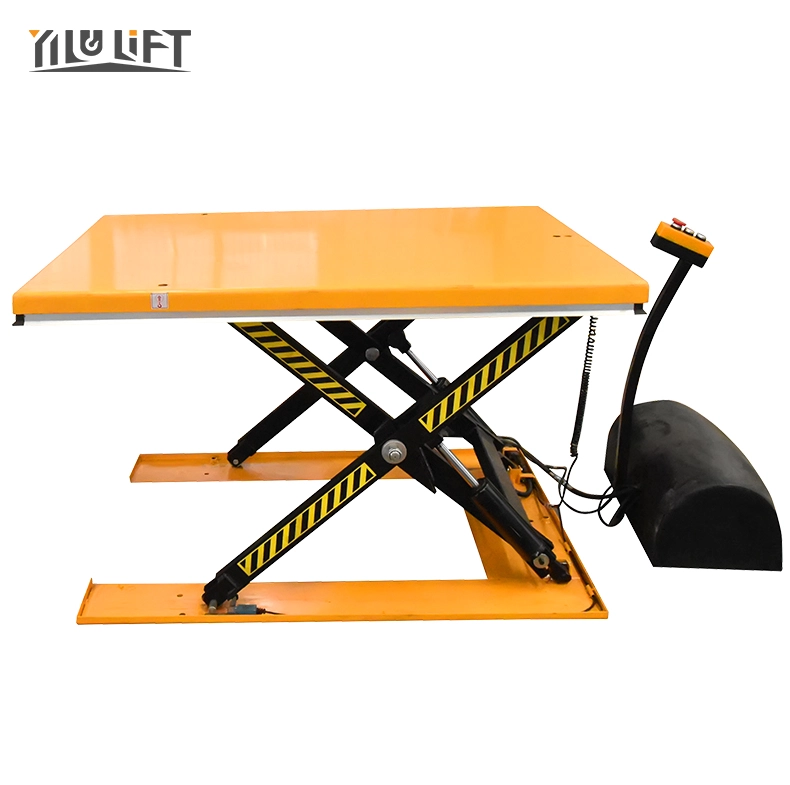
For groups requiring such portability, the 1,000–2,000 kg Super Low Working Platform represents a significant advancement. The feature that sets this apart is its extremely low initial height. Typically, achieving a lift aligned with the ground surface demands excavating a depression, which proves costly and irreversible. However, this YILU LIFT design includes its integrated incline, allowing direct loading of a pallet mover onto it. Moreover, it frequently incorporates distant operation features, providing a convenient way to monitor the rising cargo from a safe distance. Thus, it suits perfectly for operations seeking the advantages of a recessed lift without damaging the solid flooring.
Occasionally, the decision extends beyond merely fixed versus portable, encompassing the particular manner in which personnel engage with stacked loads. Conventional elevation methods can still create inefficiencies, particularly when individuals must navigate around a stack or extend over it to arrange containers. At this point, dedicated technology intervenes to connect basic raising with comprehensive process integration. These devices target the final segment of the building sequence, where minor actions accumulate into substantial time losses during a standard workday.
IV. Specialized Lifting Technology: Bridging the Gap in Material Handling
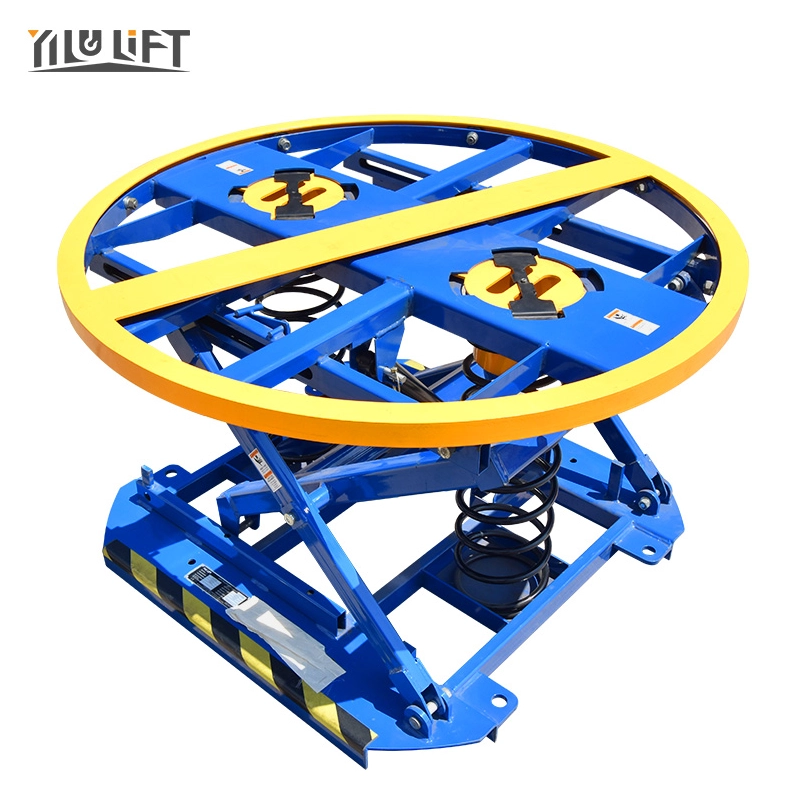
The 182–2,000 kg Pallet Positioner illustrates this dedicated strategy ideally. Rather than simply ascending and descending, it utilizes a coil-driven mechanism along with a turning platform. As the handler places additional mass, the surface descends automatically to maintain the upper section at an optimal reach for their limbs. Once they complete one aspect, they simply rotate the upper part to access the reverse side. It requires no engine or connection; the coils perform the function according to the cargo’s mass. Therefore, it offers a minimal-upkeep approach to accelerate filling sections and protect personnel from back stress.
Determining the suitable purchase generally hinges on three factors: mass, energy supply, and available ground area. When the objective involves elevating over 3 tons, a fixed variant nearly always provides the solution, owing to its fluid power and secure base. Fixed lifts moreover endure longer in frequent-operation settings because they avoid components like wheels or power cells that degrade over time. As a result, they constitute the straightforward, low-effort option for committed assembly paths.
V. Comparative Analysis: Mobile vs. Stationary Models
|
Feature |
Stationary Lift Tables |
Mobile Lift Tables |
|
Weight Capacity |
Higher (Up to 4+ Tons) |
Moderate (Usually up to 2 Tons) |
|
Fuente de energía |
Typically fixed AC power |
Battery-powered or manual hydraulic |
|
Floor Impact |
Permanent installation/pit needed |
Zero installation; rolls on casters |
|
Best For |
Fixed assembly lines |
Warehouse picking and transit |
Optimizing your heavy-duty scissor lift performance requires understanding hydraulic height adjustment limits; these units perform only as well as their upkeep allows. Since lift tables incorporate intense fluid systems and substantial metal compression areas, protection remains a critical concern that cannot be ignored. Therefore, inspecting for liquid escapes, damaged cables, or deteriorated guides every several weeks is crucial. Selecting a producer with an established history, such as YILU LIFT’s 20+ years of effective contributions in the sector, indicates that the device incorporates these protective measures right from the initial design.
VI. Maintenance and Safety Standards for Industrial Lifts
Routine protective elements, including sudden-stop controls and barrier edges that prevent foot entry beneath the surface, must remain essential requirements. It also benefits to evaluate the material strength of the metal and the joint integrity. YILU LIFT has established its standing through the toughness and dependability of its products, which aligns precisely with the needs when positioned beside a two-ton burden. Opting for inexpensive alternatives may reduce immediate expenses, but a malfunctioning lift table during a peak operational day will incur far greater losses in output duration.
Ultimately, the optimal lift table integrates seamlessly into current procedures without compelling the group to alter their methods. If tasks remain stationary, select the fixed type and benefit from the added firmness. Conversely, if operations involve movement, choose the portable option to provide the necessary adaptability.
VII. Conclusion: Selecting the Right Solution for Your Facility
Qingdao YILU LIFT Intelligent Equipment has assisted production sites in making these determinations for more than two decades, distributing trustworthy tools to over 130 nations. Through concentrating on the genuine requirements of the user, whether a minimal-height design for straightforward loading or a robust surface for building work, they ensure that the gear resolves additional issues rather than generating them. Allocating resources to suitable elevation technology stands as one of the most prudent actions a site overseer can take to sustain efficient operations and content personnel.
FAQ
Q1: Can a mobile lift table be used as a permanent workstation?
A: In principle, yes, yet it lacks the steadiness of a fixed device. When activities demand significant pressure, such as striking or intensive assembly, a portable lift could move subtly on its rollers, despite engaged locks. For such duties, a fixed version offers a superior alternative.
Q2: Do I need to dig a pit for a “Super Low” lift table?
A: No, that’s the primary advantage. Variants like the YILU LIFT Super Low Working Platform include an incline. You position it straight on the storage surface and load a pallet mover directly. This avoids the substantial expense of ground modification and preserves arrangement versatility.
Q3: How often do the springs in a pallet positioner need to be replaced?
A: The coils in a superior pallet positioner endure hundreds of thousands of operations. Provided the unit avoids repeated excess beyond its 2,000kg threshold, the coils will persist for numerous years requiring virtually no attention.
