



What Are the Different Types of Lifts for Construction Sites
What Are the Different Types of Lifts for Construction Sites
Construction sites come in all shapes and sizes. Some jobs need straight-up height, others demand reach over obstacles, and many involve moving heavy glass or panels without a scratch. The right lift saves time, cuts risk, and keeps the crew moving. At YILU LIFT, we build everything from scissor lifts to spider cranes and vacuum lifters that install curtain walls faster than a full rigging team. Here’s a clear breakdown of the main types you’ll actually see on site.
What Are Scissor Lifts?
When the job is mostly vertical and the ground is reasonably flat, scissor lifts win every time.
Stable Vertical Elevation Platforms
The platform rises straight up on a folding X-pattern support. No swinging, no drifting—just solid deck space for several workers plus tools.
Hydraulic or Electric Drive Options
Electric models run quiet and clean inside buildings. Hydraulic versions give more power and work fine outdoors on dusty yards. Both are simple to service.
YILU’s Self-Propelled Scissor Lifts for Efficient Site Mobility
Our hydraulic-driven range starts at 6 m and goes to 18 m platform height. Pothole protection, non-marking tires, and a tight turning circle let one operator zip across a busy floor without dragging a cable. Load capacity runs 500–2000 kg depending on the model, so you can carry pallets of block or drywall in one trip.
What Are Boom Lifts?
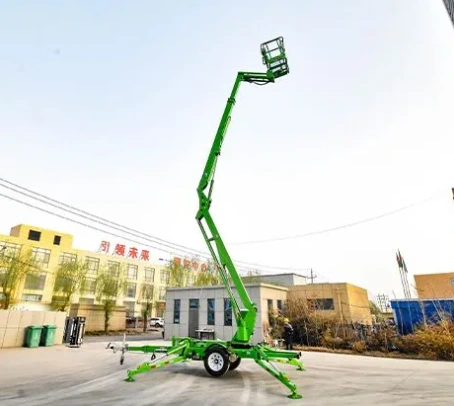
Some shooting spots are hidden behind fences, on the edge of rooftops or at half-heights on building facades, which is precisely the forte of boom lifts.
Articulated or Telescopic Arm Designs
Articulating booms (knuckle booms) fold to get over obstacles. Telescopic booms shoot straight out when pure horizontal reach matters most.
Towable or Crawler Models for Versatility
A towable boom hooks to any pickup and sets up in minutes with automatic outriggers—perfect for small contractors. Crawler versions climb slopes and soft ground that would swallow a regular truck.
YILU’s Crawler Boom Lifts for Rough Terrain Access
Our tracked articulated booms give up to 28 m working height and 15 m outreach. Diesel power with optional battery backup means you’re never stuck if the engine quits mid-job. The basket self-levels and the outriggers have load sensors so the machine refuses to lift if one leg is floating.
What Are Spider Cranes?
Tight doorways, indoor slabs that can’t take heavy point loads, or rooftop mechanical installs—spider cranes were made for these headaches.
Compact Crawler-Based Lifting Machines
Narrow legs spread wide for stability yet fold tight enough to pass through a standard double door. Tracks spread the weight so you don’t crack expensive marble floors.
Optional Torque Displays and Remote Controls
A small screen on the remote shows exact load, radius, and boom angle. If someone tries to swing too far with a heavy pick, the alarm goes off and the unloading valve kills the motion. Simple, but it stops accidents before they start.
YILU’s Spider Cranes with Custom Jib Extensions
We stock 1.2 ton all the way to 18 ton models. Pick a searcher hook, a short jib for extra height, or a hydraulic fly jib when you need to thread a chiller through a narrow window. Most customers add the wireless remote with the torque screen—once they try it, they never go back to line-of-sight operation.
What Are Vacuum Lifters?
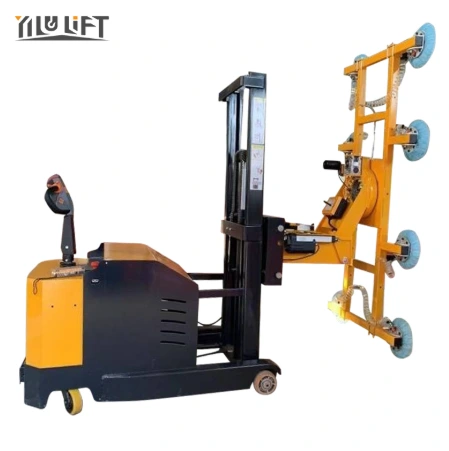
Glass, steel sheets, sandwich panels—anything smooth and non-porous hates slings and chains. Vacuum lifters grab the face instead of the edges.
Suction-Based Material Handlers
Pads pull a deep vacuum, atmospheric pressure does the holding. Dual-circuit pumps mean even if one side fails, the load stays up long enough to lower it safely.
Manual or Electric X-Type Configurations
Basic manual versions tilt and rotate by hand—cheap and reliable. Full-electric models flip 90° left/right and spin 360° with joystick buttons so one person on the ground runs the whole install.
YILU’s GL-LD Series for Safe Glass Installation
The LD range runs from 300 kg to 1000 kg. Off-road front-wheel-drive versions handle site rubble; standard rear-drive units stay nimble inside finished lobbies. Battery lasts a full shift of heavy cycling, and the vacuum reservoir holds pressure for hours if power drops. Many curtain-wall crews now finish a floor in half the time it used to take with strap rigs.
How to Select the Right Lift?
Jobs change, budgets change, ground conditions change. A quick checklist keeps you from renting or buying the wrong machine.
Assess Load Capacity and Height Needs
Write down the heaviest single pick and the highest point you have to reach. Add 20 % margin—running at 100 % all day wears everything faster.
Consider Site Terrain and Power Sources
Finished floors want non-marking tires and electric power. Muddy fields need tracks and diesel. Indoor night work usually means battery or 220 V single-phase so the generator stays outside.
We build non-standard platform sizes, special paint colors, even dual-power spider cranes that switch between diesel and 380 V without missing a beat. Drop the specs on the contact form and we usually quote the same day.
Every site has its own puzzle. The trick is matching the machine to the real daily work instead of the brochure fantasy. Get that part right and the job finishes early, the crew stays in one piece, and the rental invoice looks smaller than expected.
FAQ
Q1: How long do the batteries last on YILU vacuum lifters and electric scissor lifts?
A: Full shift on a real job—roughly 6–8 hours of actual cycling. We ship with maintenance-free AGM batteries; lithium upgrade is available if you hate topping up water.
Q2: Can spider cranes work indoors on sensitive floors?
A: Yes. Rubber track pads spread the load, and most models under 3 ton leave less than 0.5 kg/cm² ground pressure. We’ve put 3-ton units on marble lobbies without a single mark.
Q3: What’s the lead time for a custom boom lift or vacuum lifter?
A: Standard machines ship in 15–20 days. Custom paint, extra functions, or special voltage usually add another 10–15 days. Rush orders have landed in the Middle East in under four weeks when the flight schedule lined up. Just ask.
