

Electric Scissor Lift Maintenance Schedule for Rental Fleets
Electric Scissor Lift Maintenance Schedule for Rental Fleets
Rental companies operate in a harsher maintenance environment than single-site owners. رافعات مقصية كهربائية rotate among operators, applications, floor conditions, transport vehicles, and charging practices, so minor defects can become missed bookings, emergency swaps, or safety-critical failures. A structured lift maintenance schedule protects utilization, residual value, compliance, and total cost of ownership by combining inspections at each rental cycle with service based on time, operating hours, condition, and local rules. For fleet operators evaluating new assets, YILU LIFT is a Qingdao, China–based factory focused on innovative and automated development of aerial work platforms, cranes, spider cranes, vacuum lifters, suction-cup lifting equipment, and scissor lift tables.
Why Rental Fleets Need a Dedicated Maintenance Strategy
Maintenance Is a Revenue-Control Process
In a rental fleet, availability affects revenue because a machine awaiting diagnosis, charging, parts, or inspection cannot be dispatched. Planned preventive maintenance reduces early component failure, reactive repair expense, and downtime. Equipment owners are responsible for servicing and inspections, while operators conduct pre-use checks. The manufacturer’s manual sets service intervals, which may need shortening for abrasive conditions, high utilization, contamination, corrosion, or frequent transport.
Several Inspection Layers Are Required
An effective program separates pre-use, post-hire, pre-delivery, routine, periodic, and statutory inspections. These layers are not substitutes. A return check does not replace the next operator’s inspection, while workshop service does not replace a legally required examination.
Recommended Electric Scissor Lift Maintenance Schedule
Before Every Shift or Operating Day
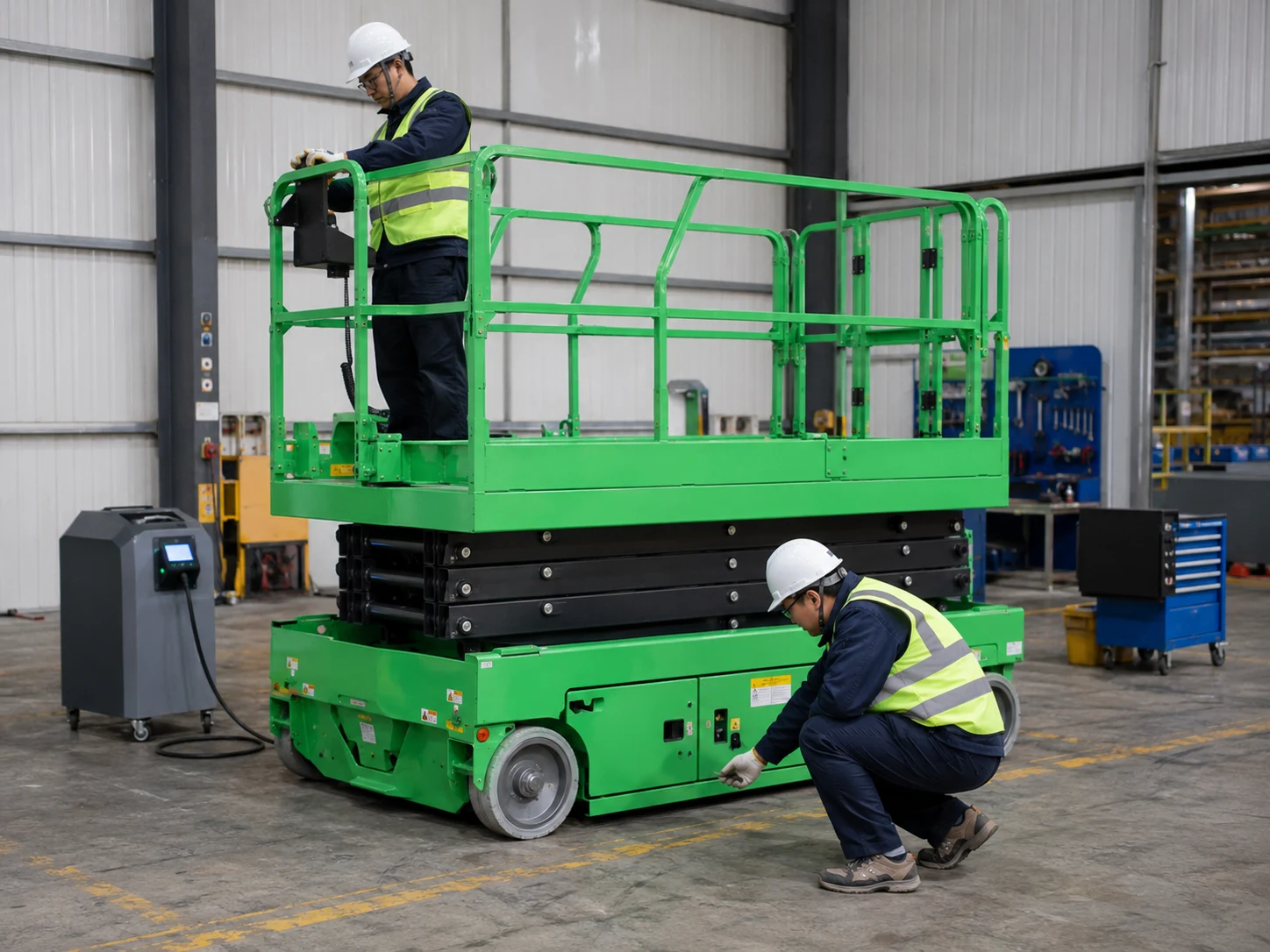
The pre-use check should cover guardrails and gates, controls, emergency stop and lowering, steering, brakes, tires, pothole protection, alarms, decals, leaks, wiring, and visible structural damage. Battery charge, charger condition, leads, terminals, and battery security also require attention. Safety-critical defects require isolation and tagging. OSHA guidance calls for controls and components to be checked before use, guardrails to remain serviceable, and brakes to hold the lift in position.
At Every Rental Return and Before Dispatch
Post-hire inspection is the main control point for electric scissor lift maintenance in rental operations. After cleaning, technicians should look for impact damage, bent rails, damaged platform extensions, loose fasteners, tire cuts, hydraulic seepage, charger damage, missing documents, and altered safety devices. A full function test should cover ground and platform controls, drive, steering, lift, lower, braking, alarms, interlocks, and emergency descent. IPAF guidance states that rental companies commonly conduct pre-delivery inspections and additional checks when equipment returns from hire, with records retained for traceability.
Battery inspection needs a separate workflow. Rental guidance recommends pre-hire and post-hire checks because flooded lead-acid batteries may return with low electrolyte, dry cells, corrosion, loose connections, or damaged casings. Distilled or de-ionized water is required where topping-up is specified. Charging must follow the model-specific manual in a ventilated area. Damaged cables, incompatible chargers, blocked vents, and extended discharge can shorten battery life and create fire or electrical risk.
Every 90 Days or at the OEM Trigger
Routine inspections are often performed at longer intervals, with 90 days cited as a common example. The governing trigger remains the manufacturer’s time-and-hour requirement, whichever comes first. High-cycle machines can reach the hour threshold early, while low-use machines still need time-based checks because batteries, seals, corrosion protection, and safety systems can deteriorate during storage.
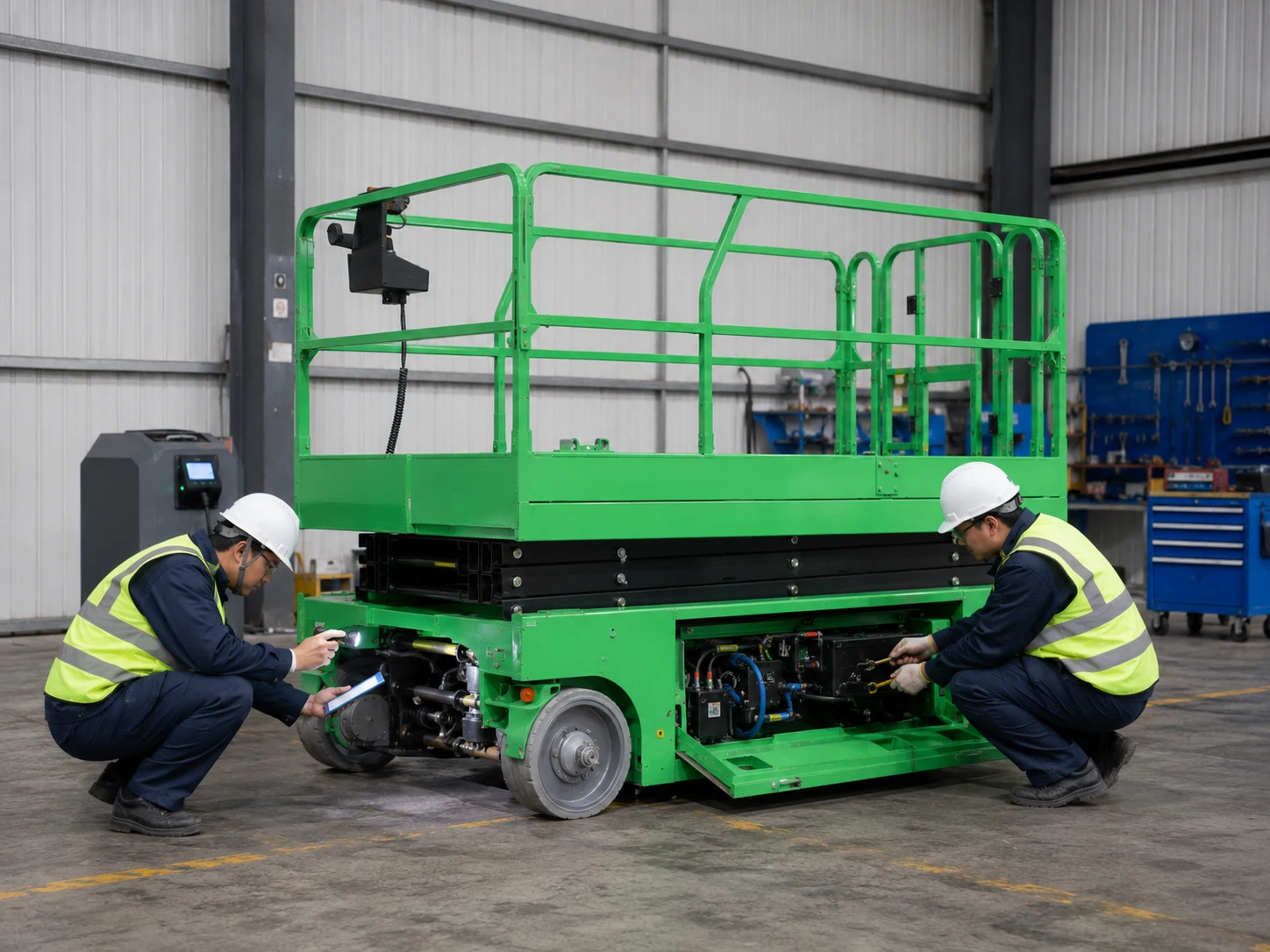
The technician’s scope should include lubrication points, pins, bushings, scissor arms, welds, platform extensions, cylinder rods, hoses, fittings, hydraulic oil, electrical harnesses, connectors, battery performance, brakes, limit switches, tilt protection, pothole devices, emergency systems, and fault history. Torque values and replacement limits must come from the service manual rather than generic workshop assumptions. Only competent and qualified personnel should perform scheduled servicing and maintenance.
Annual, Statutory, and Exceptional Inspections
Periodic or annual inspections provide deeper verification of serviceability. Local law can impose shorter periods. UK guidance, for example, requires equipment lifting people to receive a thorough examination at least every six months; other markets apply different rules. Fleet policies therefore need a jurisdiction matrix rather than one global compliance date.
Exceptional inspection should follow overload, collision, tip-over, uncontrolled descent, structural repair, long storage, major component replacement, or severe corrosion. Older machines may require major structural examination under manufacturer or regional requirements. Records should retain findings, tests, repairs, parts, technician identity, and return-to-service approval. Industry guidance also notes that major inspections may become necessary as equipment ages or when a competent person identifies structural concerns.
Practical Maintenance Matrix for Fleet Managers
A Tiered Schedule for Workshop Planning
|
Maintenance point |
Primary scope |
Responsible role |
|
Before each shift |
Controls, brakes, rails, tires, leaks, battery |
Trained operator |
|
Rental return |
Damage, charging system, complete function test |
Rental technician |
|
Pre-delivery |
Safety devices, documents, charge |
Qualified service staff |
|
Routine interval |
Mechanical, hydraulic, electrical, battery systems |
Competent technician |
|
Periodic or statutory |
Legal and OEM examination |
Competent examiner |
|
Exceptional event |
Structural and functional assessment |
Authorized specialist |
The schedule should connect with hour-meter or telematics data where available. Work orders can be triggered by date, hours, fault code, damage report, or rental return. Useful indicators include maintenance cost per rental day, mean time to repair, repeat fault rate, battery replacement rate, inspection completion, and unavailable days.
Battery and Charging Control
Standardize the Charging Environment
Charging bays should be ventilated, dry, protected from traffic, and arranged so leads cannot be crushed, submerged, or left coiled under load. Charger rating must match the battery system, and protective circuits must not be bypassed. Procedures also need isolation steps, personal protective equipment, spill response, and rules for damaged casings.
Track Condition, Not Only Charge Percentage
A full charge indicator does not confirm healthy capacity. Runtime complaints, voltage behavior, charge duration, electrolyte history, terminal corrosion, and low-voltage faults provide a stronger basis for replacement planning. Consistent records help distinguish charger faults, charging errors, weak cells, and aging packs before jobsite failure. Battery terminals, cables, casings, connections, and surrounding compartments should also remain clean and free from corrosion or debris.
Procurement Decisions That Reduce Maintenance Cost
Evaluate Maintainability Before Purchase Price
A B2B specification should assess service access, diagnostic capability, component standardization, battery configuration, hydraulic hose routing, corrosion protection, service manuals, spare-parts lead time, warranty terms, and supplier response. A lower acquisition price can be offset by slow diagnosis, non-standard chargers, difficult component access, or long parts delays.
Maintenance documentation also requires procurement-level review. The service manual must be accessible to workshop personnel and kept current with technical updates. Parts lists, wiring diagrams, hydraulic schematics, fault-code information, and inspection forms can significantly reduce troubleshooting time across a large rental fleet.
Standardize Models Across the Fleet
Model standardization reduces technician learning time and supports common stocking of chargers, controls, tires, switches, hoses, and wear parts. Procurement teams should compare rental demand, utilization, transport dimensions, floor conditions, rated capacity, working height, and projected maintenance hours before approving the model mix.
A standardized fleet can also simplify technician training, inspection templates, charger management, parts forecasting, and branch-to-branch equipment transfers. Different working heights may remain necessary, but unnecessary variation in electrical and hydraulic systems increases service complexity.
التعليمات
What must be checked after every rental?
The return inspection should cover damage, missing items, battery and charger condition, leaks, tires, rails, platform extension, controls, brakes, alarms, interlocks, emergency lowering, and fault records. The unit should not return to available status until unresolved defects have been assessed.
Who can perform maintenance and inspections?
Trained operators perform daily checks. Competent personnel handle service, routine inspections, and safety-critical repairs. Statutory or major examinations may require a specially authorized examiner under local regulations.
What causes avoidable battery failures?
Incomplete charging, damaged leads, incompatible chargers, low electrolyte, corrosion, loose terminals, deep discharge, poor ventilation, and storage in a discharged state are frequent causes.
Which records support replacement decisions?
Hour readings, inspection dates, fault codes, damage reports, battery history, parts consumption, labor hours, repeat repairs, downtime, and technician approvals support total-cost and replacement analysis.
Build a More Serviceable Rental Fleet with a Factory Partner
Request a Fleet-Oriented Equipment Proposal
For rental companies, distributors, and equipment management organizations, ييلو ليفت operates as a manufacturer, supplier, and factory in Qingdao, China. Its portfolio includes mobile scissor lifts and other aerial access and lifting equipment, while selected self-propelled scissor lift information highlights charging protection, fault diagnosis, emergency descent, non-marking tires, folding guardrails, and forklift handling points. A fleet quotation can be developed around working height, rated capacity, operating environment, quantity, destination market, spare-parts planning, and after-sales documentation. For quotations, technical specifications, dealership discussions, or rental fleet procurement support, contact YILU LIFT through its official contact channel.
