
Vacuum Lifter for Sandwich Panel Installation: What to Check Before You Buy
Vacuum Lifter for Sandwich Panel Installation: What to Check Before You Buy
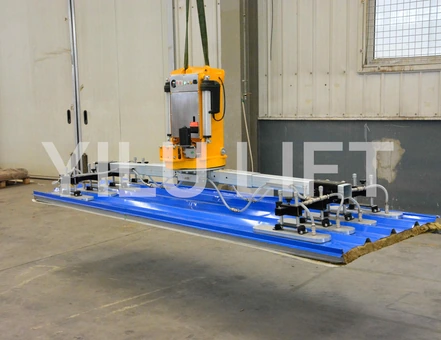
A vacuum lifter for sandwich panel installation has to match more than panel weight. Roof or wall placement, panel length, outer-skin profile, protective film, pickup direction, roof pitch, and the available crane all affect the configuration. Long insulated panels also behave differently from rigid steel plate. They can flex, twist, and expose only narrow sealing zones between ribs.
The quickest way to narrow the options is to describe the installation sequence before comparing model numbers. A panel lifted flat from a stack and placed on a sloped roof needs a different movement plan from a wall panel that turns from horizontal to vertical.
Confirm the Panel Before Comparing Lifters
Record the build-up, skin, profile, and finish
Start with the panel manufacturer’s drawing. It should show overall length and width, thickness, total weight, joint detail, rib spacing, crown height, and the flat areas available for suction pads. State whether the core is PIR, PUR, mineral wool, or another material, and identify the outer skin on the pickup side.
The contact face needs a plain description too. Is it smooth, micro-ribbed, corrugated, embossed, coated, wet, dusty, or covered by protective film? A broad phrase such as “metal panel” is not enough. A pad that seals well on one profile may bridge over a rib or leak on another.
Include the smallest and largest panels in the order. The frame may be long enough for the largest roof sheet but still need a practical cup arrangement for shorter wall panels.
Mark no-contact areas on the drawing
Panel joints, trims, fixings, labels, damaged areas, and deeply profiled sections can limit cup placement. Mark these zones before the lifter is selected. That gives YILU LIFT a usable basis for cup quantity, pad size, crossarm position, and extension-beam layout.
Protective film needs its own note. The cup may seal to the film while the bond between film and coating remains uncertain. Ask whether the proposed method requires film removal at the pad positions or a sample test with the actual panel finish.
Separate Roof Installation from Wall Installation
Show the pickup and final angles
For roof work, record the roof pitch and the panel angle at pickup. Then describe how the panel moves from the stack to the roof. Does it stay close to horizontal, or must it tilt during the lift? For wall work, state whether the panel is picked flat and turned upright, or supplied vertically from a rack.
These details affect the frame, suspension point, movement function, and operator control. They also affect the space needed around the panel. A long wall panel rotating near columns or scaffolding needs a route drawing, not just a final installation height.
The current YILU LIFT sandwich-panel range presents options for roof-pitch bands of 0–25° and 25–45°. Share the actual project angle so the proposed model can be matched to the planned installation rather than selected from the panel length alone.
Treat horizontal-to-vertical movement as a defined task
Do not assume that every panel vacuum lifter can turn the load in the same way. State the required tilt or rotation angle and whether the action is occasional or repeated on every panel. Ask which functions are powered, which are manual, where the operator stands, and how the load is controlled through the change of angle.
This is particularly important for wall installation. The lifter may grip the panel securely at pickup yet still be awkward to guide into the joint if the suspension and control arrangement do not suit the final orientation.
Match Frame Length and Cup Spread to Panel Length
Support the long panel without oversizing every lift
Long sandwich panels need support across a useful span. If cups are concentrated too close to the centre, unsupported ends can move in wind or flex during acceleration. If the frame is much longer than the panel, setup becomes cumbersome and some cups may fall outside the usable sealing zones.
Use the panel drawing to set the active cup spread. The arrangement should work with the panel’s profile and keep the pickup balanced around its centre of gravity. Extension beams can help one lifter cover several lengths, but each planned configuration still needs a clear cup pattern.
Ask for a simple layout showing the lifter length, extension positions, active pads, and panel overhang for the main sizes. That drawing is more useful than a capacity number on its own.
Check the complete suspended load
The crane carries the panel, vacuum lifter, hook, and any rigging. Add all of them when checking crane capacity at the required radius. Also record hook height, lifting height, the position of the panel stack, and the landing point. Roof edges, parapets, scaffolds, and nearby structures can increase the required outreach.
The panel’s rated weight should come from the supplier or project schedule. Do not estimate it only from nominal thickness. Facings, core density, length, joint details, and attached components can change the total.
Verify Pad Contact on the Real Panel Surface
Use the profile drawing to place the pads
Sandwich-panel pads are usually longer and narrower than round plate-lifter cups because they need to find repeatable sealing lanes on the sheet profile. Rib spacing and flat width therefore matter. The pad must sit where the seal can make full contact, not partly on a crown, joint, or damaged edge.
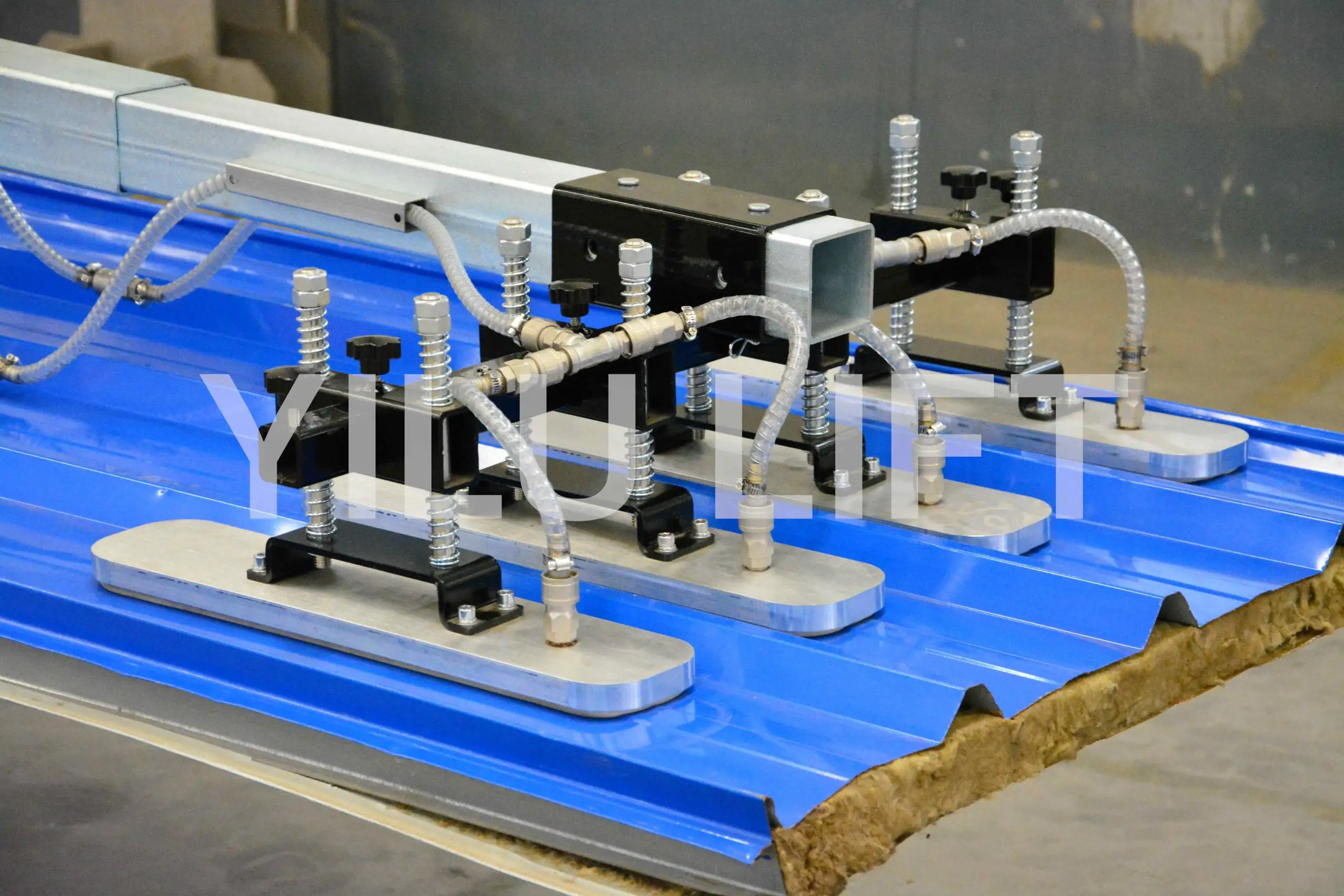
The YILU LIFT product information shows multi-pad layouts with adjustable supports. Selected models also describe independent air inlets, allowing individual cups to be taken out of use when the approved configuration calls for it. The exact active-pad pattern should still be stated for each panel size.
Ask for a sample test when the finish is unfamiliar
Micro-ribbed, deeply corrugated, embossed, filmed, or weathered surfaces should not be cleared from photographs alone. Send a sample or an offcut with the same profile and finish. Ask YILU LIFT to confirm the proposed pad and test arrangement before site delivery.
A representative test can also reveal whether the panel skin marks easily, whether film must be removed at contact points, and how consistently the pads seal across normal manufacturing tolerances.
Plan the Crane Interface and Site Sequence
The vacuum lifter is one part of the lift. The crane must reach the pickup and placement points with the complete suspended load, while the site needs enough room for panel rotation and controlled landing. Include the crane type, hook connection, available headroom, working radius, and any restriction on where the panel stack can sit.
For roof work, add roof pitch, eave height, ridge height, panel direction, and the planned landing sequence. For wall work, show bay width, column positions, scaffold or platform locations, and joint direction. State whether installation is indoors, outdoors, or partly enclosed, then confirm operating limits against the selected model’s instructions and the site lift plan.
Power and control should also follow the sequence. Battery operation can keep the unit independent of a trailing cable. An optional remote control may help when the operator needs a better view of panel alignment. Confirm battery, charger, control range, warning devices, and the response to low vacuum or power interruption for the exact configuration.
Use the YILU LIFT Range as a Shortlist
ال YILU LIFT sandwich panel vacuum lifter range lists configurations for panels from 12 to 26 metres long. Published maximum loads run from 200 to 500 kg, with two to sixteen suction pads depending on the model and panel arrangement. Product information also covers detachable frame sections, battery operation, optional remote control, and pressure-retention features on selected configurations.
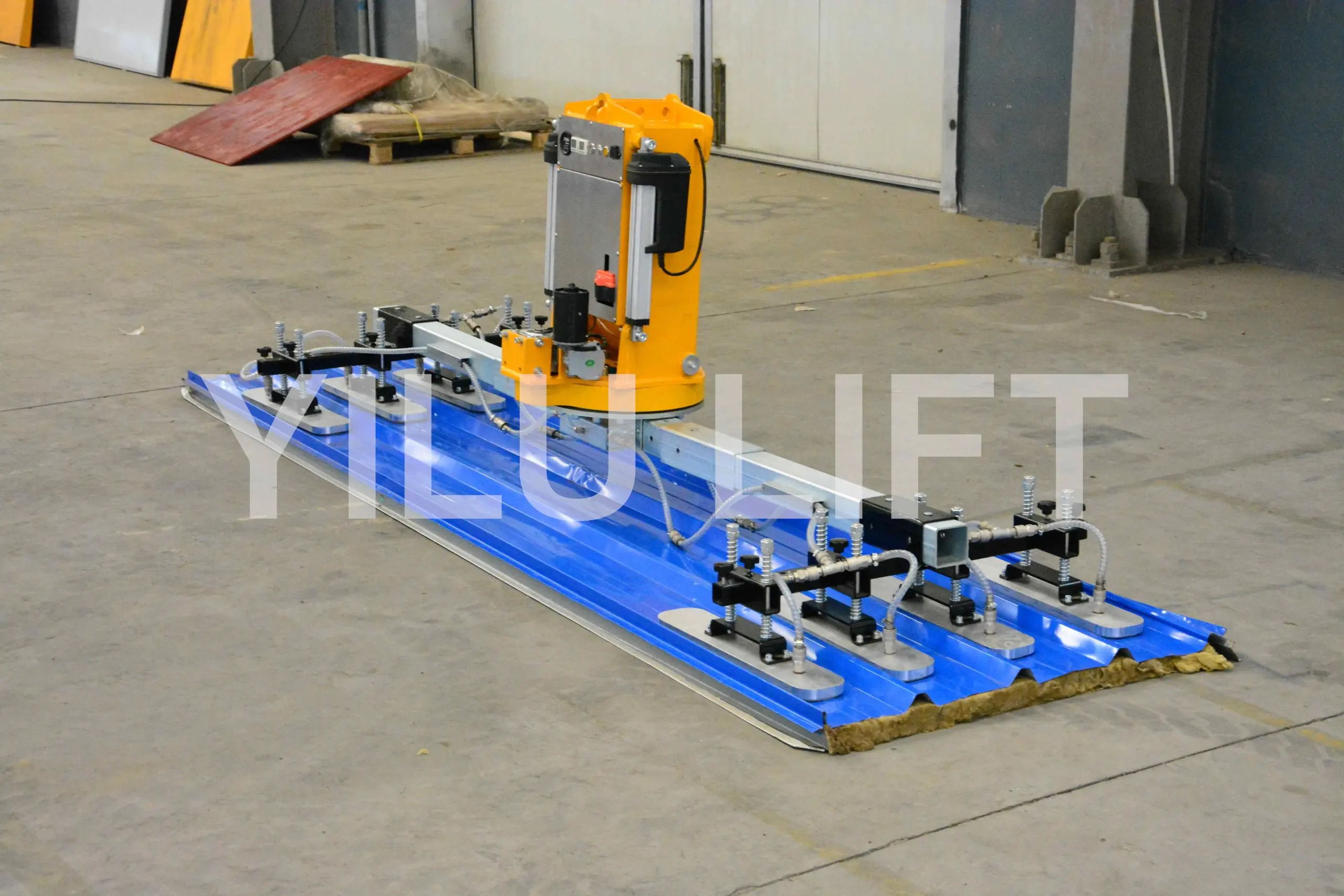
Use those figures to identify a model family, then check the exact panel profile, length, weight, pitch, orientation, pad pattern, and crane interface. Two panels with the same length and weight may still need different pads or frame setups when their skins and rib patterns differ.
Send a Panel Installation RFQ That Can Be Checked
Include the following with the enquiry:
- panel manufacturer and profile drawing;
- core type, skin material, coating, texture, and protective film;
- minimum and maximum length, width, thickness, and confirmed weight;
- roof or wall application and the actual roof pitch;
- pickup orientation, final orientation, and required tilt or rotation;
- flat sealing lanes, rib spacing, joints, and no-contact areas;
- crane type, hook height, radius, site layout, and panel-stack position;
- installation rate, shift length, power preference, destination, and quantity;
- requested manuals, inspection information, spare parts, packing, and training material.
Photos of the project are useful, but they should accompany the drawings rather than replace them. A marked panel profile and one site section usually make the technical discussion much faster.
التعليمات
Can one vacuum panel lifter install both roof and wall panels?
Some configurable lifters can support both tasks, but the approved frame, suspension, pad arrangement, and movement method may change. Send both installation sequences and ask for each setup to be identified in the quotation.
Is panel length enough to select the extension beams?
No. Length is important, but weight, stiffness, profile, centre of gravity, cup contact zones, and permissible overhang also affect the layout. Use a drawing for the actual panel family.
Can a sandwich panel lifter grip corrugated or film-covered panels?
Compatibility depends on the profile, flat sealing area, pad design, film adhesion, and test result. Provide a panel sample or offcut when the surface has not already been confirmed for the proposed pad.
Turn the Panel Drawing into a Project Configuration
The strongest enquiry is not “What is the price of a 500 kg lifter?” It is a short installation brief showing the panel and the route. Send YILU LIFT the profile drawing, length and weight range, roof pitch or wall orientation, pickup method, crane data, site section, and expected daily volume. That gives the technical team a solid basis for the frame, pad pattern, movement, power, and control proposal. Contact YILU LIFT with the sandwich-panel installation details to request a configuration review and quotation.