
Stationary Lift Table Selection: Load, Deck, and Installation Checks
Stationary Lift Table Selection: Load, Deck, and Installation Checks
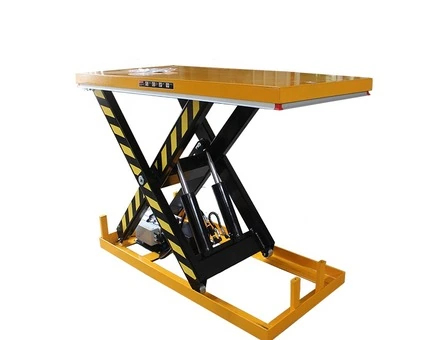
A stationary lift table is selected by the load, the deck, and the way goods arrive and leave the workstation. The most useful model is not always the one with the highest capacity. Platform size, lowered height, lifting range, control method, guarding, and the available floor space can matter just as much. A table that fits the pallet but cannot be loaded safely is not a good match.
For a new station, start with the handling cycle rather than the catalogue name. Define the heaviest load, its footprint, the required working height, and how the load will be transferred. YILU LIFT’s stationary scissor lift table range includes standard, U-shape, low-profile, pallet-positioner, and customized formats. The right choice depends on which part of the cycle the table must solve.
Start with the Load and the Working Cycle
Use the complete working load
Record the product, pallet, container, fixture, and any tooling that will sit on the platform at the same time. If the table receives a loaded pallet, the pallet is part of the working load. If an operator uses a cart, turntable, roller section, or fixture on top, include that weight as well.
The normal load and the occasional maximum load should be listed separately. A table that is acceptable for a light daily load may not be suitable for a heavier changeover. The loading direction also matters. A centered load behaves differently from a pallet pushed onto one edge, especially while the platform is rising or lowering.
Describe what happens before and after the lift
Write down the complete sequence: pallet truck approach, transfer onto the platform, lifting, picking or packing, lowering, and removal. This reveals whether the table needs a ramp, a roller top, a rotary platform, a guardrail, or a particular control position.
YILU LIFT groups several stationary scissor lift table formats for different handling points. A fixed workstation, a low-level loading point, and a pallet-positioning station should not be compared only by rated load. They solve different handling problems.
Match the Platform to the Load Footprint
Check pallet size, overhang, and access sides
Measure the pallet or container in both directions. Then check where the pallet truck forks, carts, or operators need to approach. The platform should support the load without relying on an unsafe overhang, and it should leave room for the operator to control the transfer.
Standard stationary tables in the YILU LIFT product manual are offered with different platform sizes and lifting capacities. The table should be read as a model family rather than one universal specification. Platform length, width, self-height, maximum platform height, and lifting time all change between models.
Choose a deck that supports the actual process
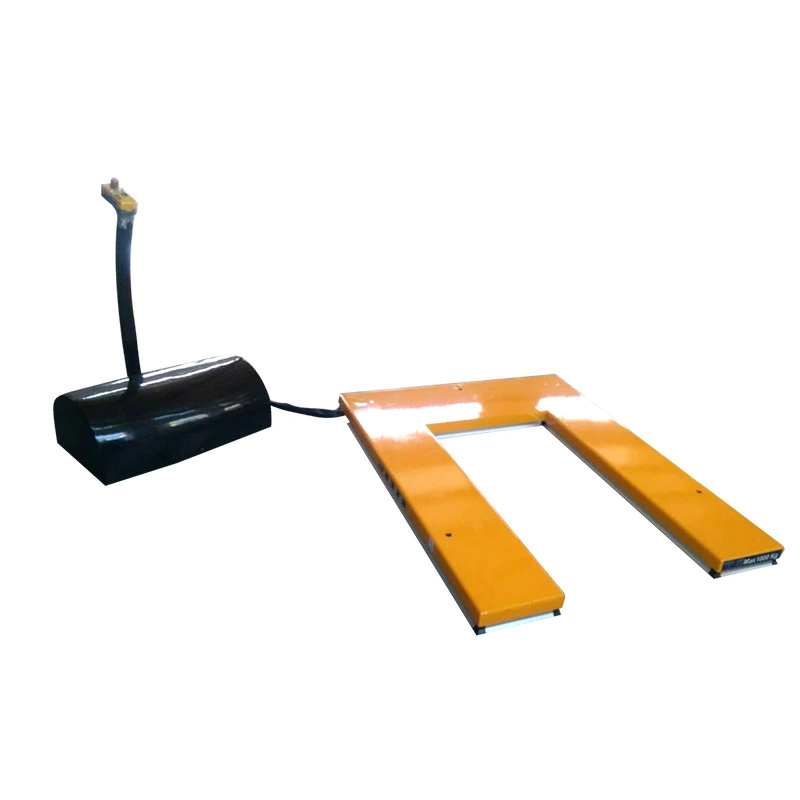
A flat platform suits many fixed loading points. A U-shape platform can simplify pallet entry when a pallet truck needs to approach from the floor without a separate ramp. The YILU LIFT U-shape platform is the relevant format to review when fork approach is the main constraint. A roller top can help where cartons or pallets must move across the deck, but it changes the transfer and restraint requirements. A rotary platform supports turning at the workstation, but the rotating load must remain stable throughout the movement.
These are not cosmetic options. Each one changes how the load is placed, controlled, and removed. The deck should be selected together with the pallet truck, conveyor, cart, or fixture that will connect to it.
For a quick first comparison:
- Standard stationary table:a fixed flat deck for a defined loading point; confirm anchoring, transfer equipment, and maintenance access.
- U-shape table:floor-level pallet-truck entry; confirm fork spacing, pallet dimensions, approach direction, and withdrawal clearance.
- Low-profile table:a lower starting height for direct floor transfer; confirm self-height, ramp or wheel clearance, and the available lift range.
- Pallet positioner:a repetitive picking station; confirm pallet height, changing load, rotation needs, and the operator’s working zone.
- Customized table:an interface with a conveyor, pit, vehicle, or fixture; provide a drawing or marked photo before final configuration.
Set the Lowered and Raised Heights Before Comparing Models
Lowered height controls the approach
Measure the height of the incoming pallet, cart, or floor-level transfer. A low-profile table can make a major difference when the load must be approached directly by a pallet truck. The YILU LIFT low-profile lift table is the relevant product direction when lowered height and ramp access are the deciding points. The product manual’s low-profile examples (manual p.6) show self-heights around 85 to 105 mm and maximum platform heights around 860 to 870 mm for the listed models.
That does not mean every low-profile table has the same capacity or deck size. The incoming equipment, floor flatness, wheel clearance, and any required ramp still need to be checked.
Raised height controls the operator’s reach
Set the working height from the real task. Packing, assembly, picking, and inspection may each need a different comfortable height. A higher maximum lift is not automatically better if it creates an awkward approach or exceeds the available overhead clearance.
If operators work around the platform, check the edge protection and pinch points at every position. If a table is installed beside a conveyor or machine, measure the height of the adjacent surface rather than relying on a nominal target.
Select the Table Format by Application
Standard stationary tables for fixed workstations
A standard stationary scissor lift table is a practical starting point when the table is installed at one repeatable loading position. The product manual lists standard models with capacities from approximately 1,000 kg upward and multiple combinations of platform size, self-height, maximum height, lifting time, and net weight.
Use this format when the station has a clear floor area and the load can be transferred onto a flat deck. Confirm how the table will be anchored, how maintenance access will be provided, and whether the surrounding equipment leaves enough room for safe operation.
U-shape tables for pallet-truck access
U-shape models are suited to floor-level pallet handling where a pallet truck needs to enter the platform area. The manual identifies the HU600, HU1000, and HU1500 examples (manual p.5) at 600, 1,000, and 1,500 kg, with a lowered height of about 85 to 105 mm and platform sizes matched to each model.
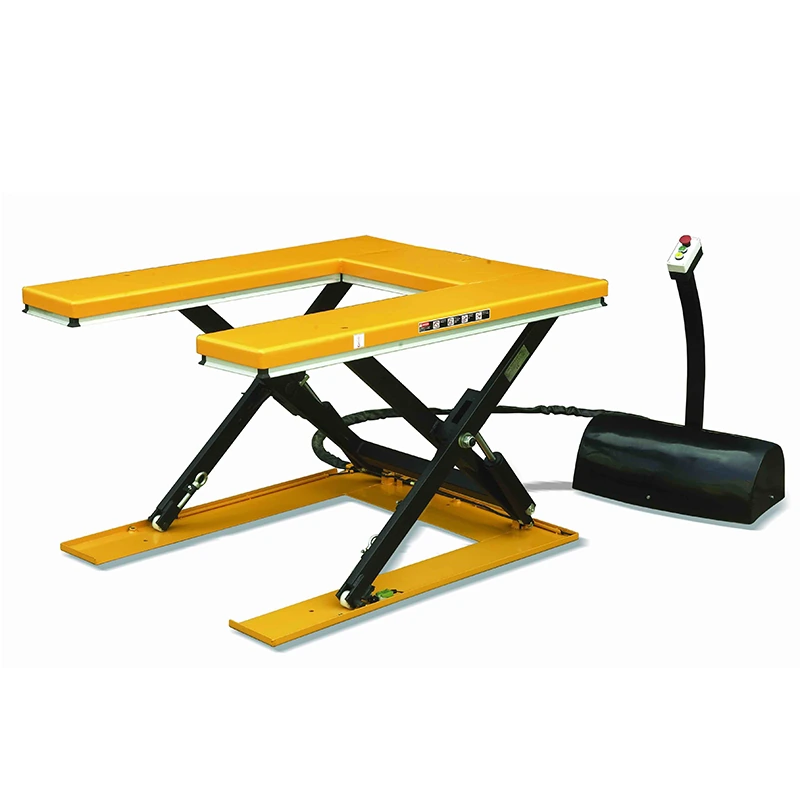
The key question is not only whether the U opening accepts the forks. Check the pallet dimensions, fork spacing, approach angle, and the clearance required to withdraw the truck after the load is raised.
Pallet positioners for repetitive picking
A pallet positioner is useful when the task is to keep the top of a pallet near a comfortable picking height as the load changes. The YILU LIFT spring-loaded pallet positioner is the relevant product direction when changing load height and operator reach matter. The HW2000A example identified in the manual (p.6) covers 182 to 2,000 kg, accepts a pallet up to 1,270 x 1,270 x 1,820 mm, and uses a spring-lift construction with a rotary platform.
This format should be evaluated by pallet height, load change, rotation needs, and the operator’s working zone. It is a different solution from a simple platform used only to raise a load to one fixed height.
Customized tables for a defined interface
Customization makes sense when the table must connect to a conveyor, pit, vehicle platform, production fixture, or unusual deck. Provide the load capacity, platform size, lifting height, lowered height, opening direction, and any control or safety requirements. A photo or marked drawing is usually enough to begin the discussion.
Confirm the Power and Safety Arrangement
The table’s pump station, cylinder, pressure-relief valve, flow-control valve, check valve, and anti-pinch arrangement all affect the operating sequence. For the listed stationary designs, the product manual (p.5) describes heavy-duty cylinders with a drainage system and check valve, pressure relief for overload protection, adjustable descent speed, and a minimum safety sensor under the platform. These are listed design features, not a blanket specification for every customized configuration.
Confirm the power supply, control position, emergency stop arrangement, floor condition, guarding, and clearance around the scissor mechanism. A pit or conveyor interface should be agreed before fabrication.
Plan the Installation Space, Not Only the Deck Size
Leave room for the platform to move through its full range and for people to approach the working side. Check nearby columns, racks, conveyors, doors, guardrails, and maintenance access. A drawing should show the table in its lowered and raised positions.
Clarify delivery, positioning, anchoring, connection, and maintenance. Include any pit, ramp, guardrail, or special deck in the early enquiry.
SSS
Is a stationary lift table the same as a pallet lift table?
Not always. A stationary lift table is a broad equipment format. A pallet lift table may be configured for a particular pallet size, loading method, or picking cycle. Compare the deck, lowered height, transfer equipment, and work sequence rather than using the names as exact substitutes.
When is a U-shape lift table useful?
It is useful when a pallet truck needs to approach a floor-level platform directly. The pallet size, fork position, approach direction, and withdrawal clearance still need to match the selected model.
What should be included in a lift-table request?
Send the maximum working load, pallet or product dimensions, required lowered and raised heights, deck format, loading equipment, available floor space, power supply, and any pit, ramp, roller, rotary, guardrail, or control requirements.
Prepare a Stationary Lift Table Enquiry
The most useful first message includes the load, deck footprint, lowest transfer height, target working height, and a short description of how the load enters and leaves the station. Add a photo or layout sketch if available.
Send the working conditions through YILU LIFT’s enquiry form when the load, deck, height, transfer method, and installation space are ready. That gives the model discussion a useful starting point, whether the application calls for a standard table, a U-shape deck, a low-profile arrangement, a pallet positioner, or a customized setup. A photo of the loading point or a simple sketch of the transfer path can make the first discussion much clearer. A few accurate measurements are more useful than a long general description.