

How to Calculate Cherry Picker Working Radius for B2B Job Sites
How to Calculate Cherry Picker Working Radius for B2B Job Sites
Calculating cherry picker working radius is a core procurement requirement. A wrong assumption can produce equipment that reaches the stated height but cannot access the work point when facades, pipe racks, parapets, trenches, or setup restrictions separate the machine from the task. For contractors, rental fleets, distributors, facility operators, and engineering teams, site geometry must be matched with the working envelope, platform capacity, access route, ground conditions, and operating limits. As a Qingdao-based manufacturer of aerial work platforms and lifting equipment, YILU LIFT supports industrial buyers evaluating project-specific access configurations.
What Cherry Picker Working Radius Means
Radius, Outreach, and Working Envelope
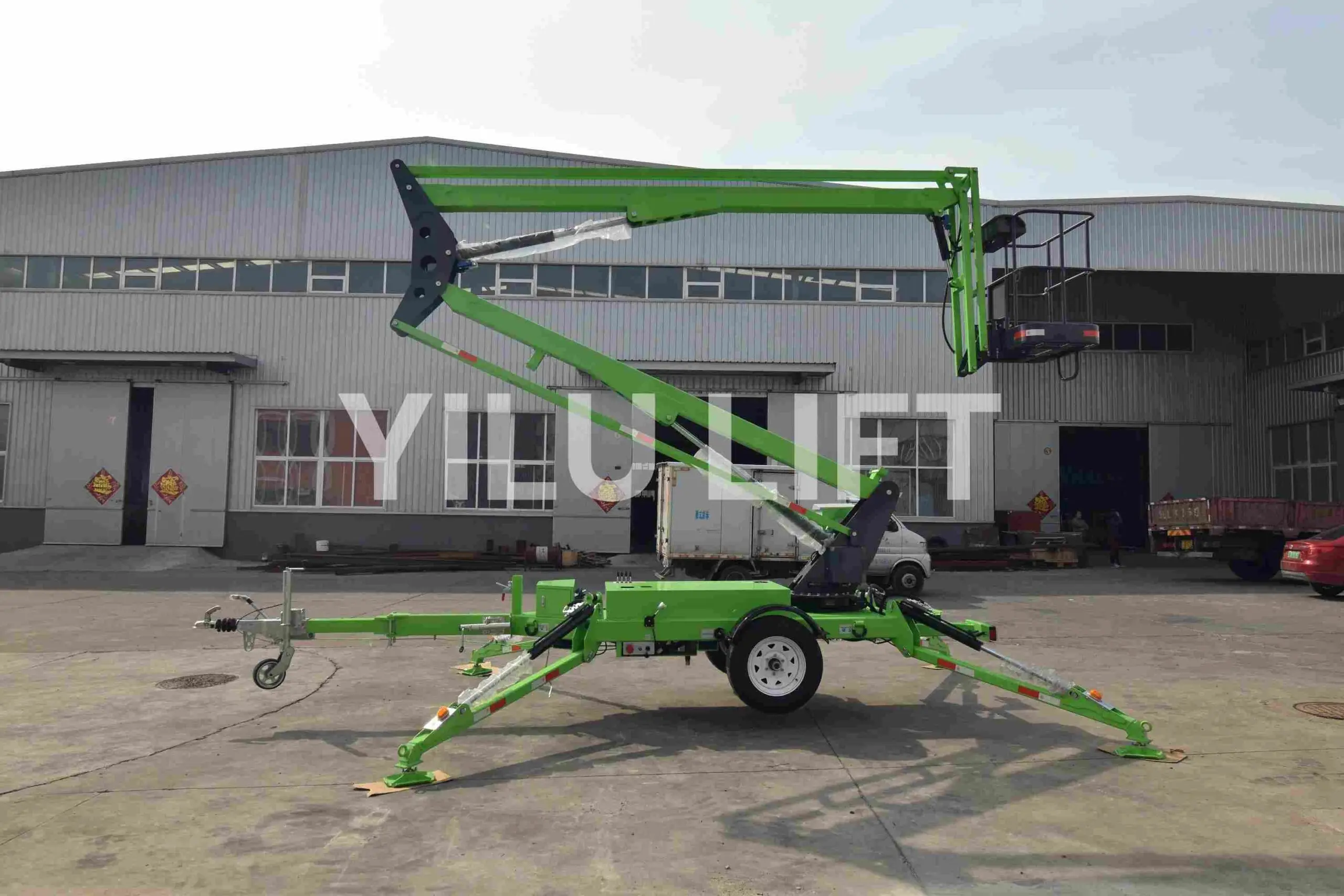
Working radius is the horizontal distance from the rotation or slewing centerline to the platform reference point at a particular boom position. It should not be measured from a tire, chassis edge, or outrigger pad. Horizontal outreach often describes the published maximum, while the working envelope combines horizontal and vertical capability across permitted positions.
This distinction controls any nacelle élévatrice reach calculation. Maximum outreach is generally available only within part of the height range, often decreasing near maximum platform height. The range-of-motion chart therefore controls selection. Industry guidance states that operational envelopes are shown in range diagrams and that leaving the permitted envelope creates an overturn risk.
How to Calculate Required Radius
Establish the Centerline and Target Point
A reliable cherry picker horizontal outreach calculation starts with a scaled plan or measured survey. Define the slewing center as the origin, then record the work point’s horizontal coordinate and elevation.
Required horizontal radius = horizontal distance from slewing centerline to work point
Assume a facade task is 14.0 m above grade and the slewing centerline must remain 8.2 m from the facade. The required radius at that elevation is 8.2 m. A model advertising 10.0 m maximum outreach is not automatically suitable; its boom lift reach chart must show at least 8.2 m at 14.0 m elevation.
Add Setback and Normalize References
Excavation edges, traffic lanes, guardrails, underground services, stored materials, or outriggers can push the base farther from the target. These offsets belong in the geometry before comparison.
Platform reference conventions also require confirmation. One datasheet may measure to the platform centerline, while another uses the platform edge. Quotations should be normalized to one datum. No basket-length allowance should be added until the supplier confirms the measurement method. Any positioning margin should be project-specific and approved by a competent planner rather than applied as a universal percentage.
When Trigonometry Supports the Calculation
Straight-Boom Approximation
For an idealized straight boom with effective length L and angle θ above horizontal:
R = L × cos θ
H = pivot height + L × sin θ
These equations support preliminary layouts but cannot replace the manufacturer’s chart, which accounts for overlap, offsets, jibs, deflection, leveling, software limits, and stability controls.
Articulated-Boom Geometry
For a simplified articulated configuration:
R = L₁ cos θ₁ + L₂ cos θ₂ + L₃ cos θ₃ + fixed horizontal offsets
This explains why an articulated boom lift working envelope can reach over an obstruction. However, joint limits and control restrictions may prohibit theoretically possible positions, so final approval must rely on the certified chart.
Turn Radius Data into a Procurement Specification
Match Radius and Height as One Coordinate
An RFQ should state horizontal radius and platform elevation as one coordinate pair. Listing “14 m height” and “8 m outreach” as unrelated maxima can attract offers that still fail on site. The request should also identify below-grade access, side reach, facade coverage, or continuous slewing.
Check Up-and-Over Clearance
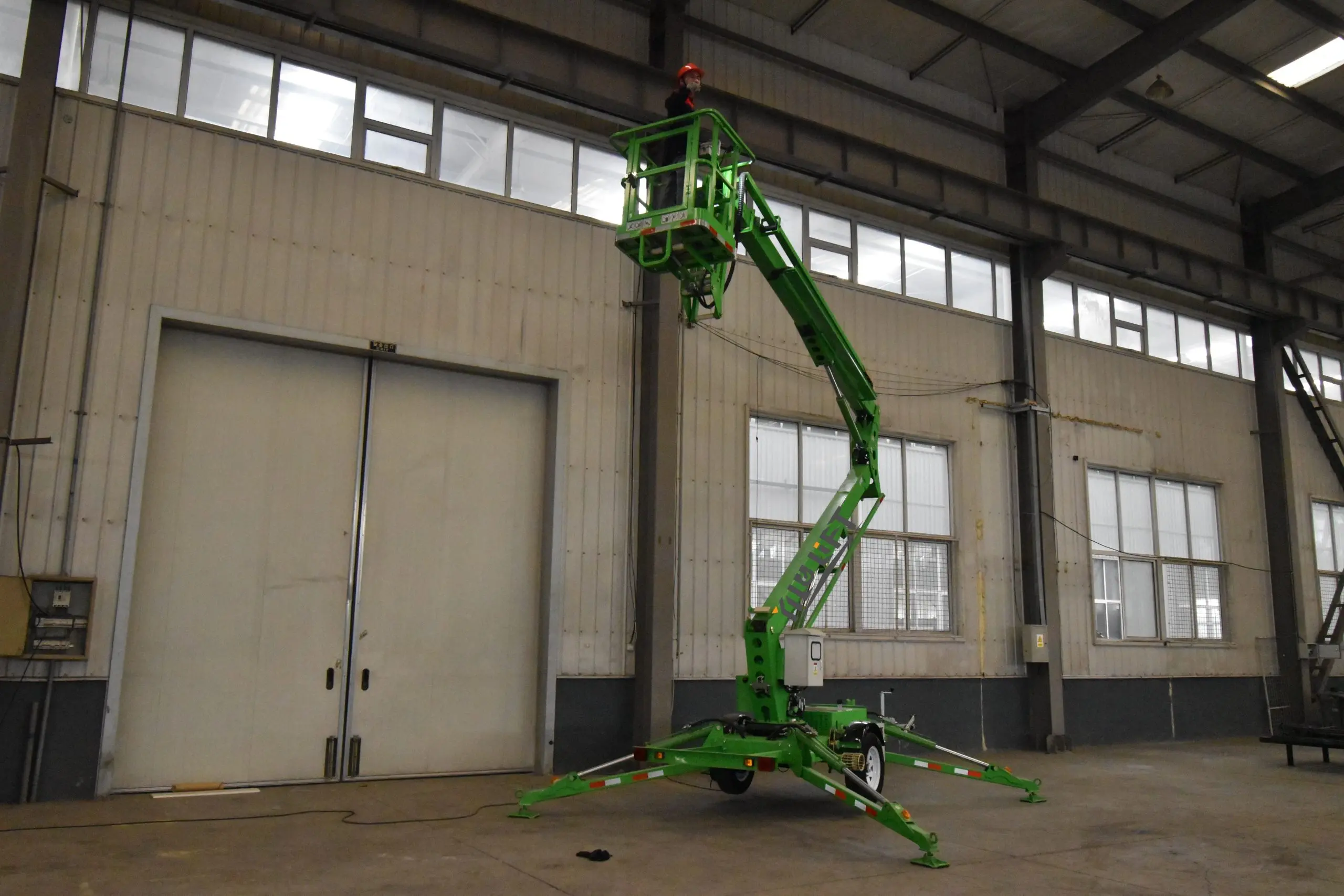
Aerial work platform selection for construction sites often depends on obstacle clearance rather than maximum reach alone. Articulating booms can reach up and over objects, while straight telescopic arrangements follow a more direct path.
The RFQ should record obstacle height, depth, minimum platform clearance, and the target beyond the obstruction. Sufficient maximum reach does not guarantee adequate up-and-over height.
Verify Capacity at the Target
Rated platform capacity must include personnel, tools, materials, accessories, and approved attachments. Safety guidance requires combined platform load to remain within capacity and prohibits exceeding vertical or horizontal reach limits.
Some machines allow different capacities in different parts of the envelope. Procurement teams should request allowable load at the exact target coordinate, not only the headline basket rating.
Confirm Setup and Ground Constraints
Calculated radius has little value if the machine cannot remain stable at the setup point. Review should cover travel width, stowed height, turning space, gradeability, tires or tracks, outrigger footprint, floor loading, ground capacity, wind limits, emissions, and power.
Site assessment guidance emphasizes surface strength, slope, hidden weak areas, and possible stabilizers or load-spreading measures.
Common Errors in Radius Planning
Treating Maximum Outreach as Universal
The maximum horizontal reach of a boom lift is a boundary value, not a guarantee throughout the vertical range. The planned coordinate must sit inside the envelope at the intended load.
Measuring from the Wrong Datum
A measurement from a tire or body panel can understate the real radius when the rotation center lies farther back. Site drawings and supplier data must use a common reference.
Closing the Gap with Unsafe Practices
Working radius should place the platform in a normal position. Leaning over guardrails, climbing on rails, or placing ladders inside the platform cannot compensate for insufficient reach; safety guidance warns against these practices.
Ignoring Exclusion Zones
Clearances from energized lines, structures, traffic, and excavation edges can change the feasible setup point. In the United States, federal guidance specifies at least 10 ft (3 m) from overhead power lines for aerial-lift work; applicable local rules may require more.
B2B Radius Verification Checklist
Minimum Technical Data for an RFQ
|
Field |
Project Record |
|
Target coordinate |
Platform elevation and radius from slewing center |
|
Obstructions |
Height, depth, and distance from the datum |
|
Charge de la plateforme |
Personnel, tools, materials, and accessories |
|
Setup area |
Chassis position, outrigger footprint, and exclusion zones |
|
Ground |
Surface, slope, bearing capacity, and hidden voids |
|
Access route |
Width, height, turning space, gradients, and floor limits |
|
Environment |
Wind, noise, emissions, temperature, and power |
|
Documentation |
Range chart, manual, certificates, inspection, and parts support |
FAQ
Is Maximum Outreach Available at Maximum Platform Height?
Usually not. Outreach changes with boom angle, extension, articulation, load, and control limits. The working-envelope chart must confirm the target coordinate.
Can Trigonometry Replace the Range Chart?
No. Geometry supports preliminary planning, but certified limits include stability, structural, and control factors that basic equations do not capture.
What Should a Boom-Lift RFQ Include?
The RFQ should include target height and radius, obstacle profile, capacity at the target, ground conditions, access dimensions, environment, duty cycle, compliance requirements, and technical documentation.
How Much Additional Radius Should Be Specified?
No universal margin fits every project. The allowance should reflect survey accuracy, setup tolerances, platform reference conventions, operating movement, and the approved site risk assessment.
For distributors, contractors, rental fleets, and industrial procurement teams, ASCENSEUR YILU is a manufacturer and factory in Qingdao, China, covering aerial work platforms, boom lifts, cranes, spider cranes, vacuum lifting equipment, suction-cup lifting systems, and scissor lift tables. Project inquiries can include target height, required working radius, platform load, obstacle drawings, access dimensions, ground conditions, destination market, and order quantity for configuration review and quotation. Technical inquiries and RFQ submissions can be sent to sales@yilulift.com or submitted through the YILU LIFT contact page.
