
Spider Crane Lifting Capacity: How to Read the Numbers Before You Buy
Spider Crane Lifting Capacity: How to Read the Numbers Before You Buy
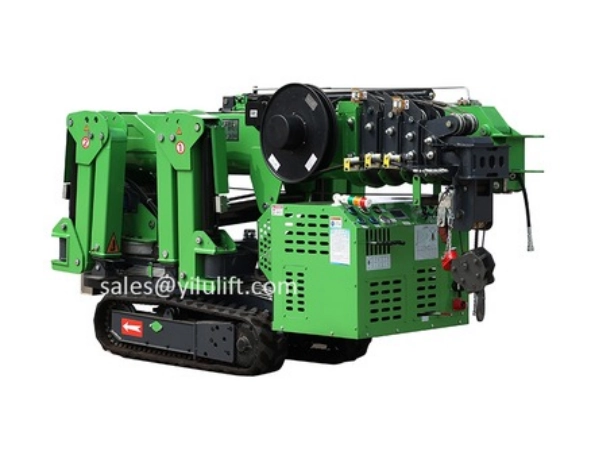
Spider crane lifting capacity is not one fixed number. The rated tonnage in a model name normally applies only within a defined working radius and crane configuration. Move the load farther away, extend the boom, change the outrigger setup, or add a heavy hook block and lifting attachment, and the allowable payload can drop sharply. Buyers comparing a mini spider crane need the load chart and job geometry before they need a price.
Treat Rated Tonnage as a Starting Point
Maximum capacity belongs to a specific condition
A spider crane described as 3 ton or 5 ton is not able to lift that load everywhere within its range. Maximum capacity is generally available close to the machine, with a stated boom and outrigger configuration. At a longer radius, the same crane may be limited to a fraction of its headline rating. The useful question is not only, “How many tons can it lift?” It is, “What can this model lift at the required radius, height, boom length, and setup?”
A heavier nominal model can cost more to buy, transport, and position, yet an undersized model may never perform the critical lift. Plot the job envelope first, then check every planned pick against the applicable model chart.
A load chart connects geometry to allowable load
A proper spider crane load chart normally organizes capacity by working radius and boom length, with notes for hook arrangement, outrigger extension, slew area, and other conditions. Working radius is the horizontal distance from the crane’s center of rotation to the load line. It is not simply the distance from the track, outrigger foot, or side of the machine.
Once the exact model is identified, use the chart entry for the required radius and boom length, then apply its notes for hook arrangement, outrigger position, and slew area. To confirm the applicable YILU LIFT model information, send the planned load, attachment weights, radius, height, and site constraints through the contact page.
Build the Job Envelope Before Comparing Models
Start with the farthest heavy pick
List the load weight, pickup point, placement point, required height, and horizontal radius for each critical lift. The governing case is often not the heaviest item. A lighter panel placed deep inside a facade opening can require more reach and leave less chart capacity than a heavier item lifted close to the crane.
Include the approach path. A crawler spider crane may travel through a restricted opening in its folded state, but its operating footprint with outriggers deployed can be much larger. Confirm that the crane can stand where the drawing assumes. Moving it even one metre farther away can change the applicable chart row.
Check boom length and angle together
Two lifts at the same height may need different boom lengths because their radii differ. A long boom does not automatically mean useful capacity at full reach. Mark the required point on the working-range diagram, then read the chart for the boom configuration that can actually reach it.
Sales phrases such as long arm, fly jib, or maximum lifting height need careful review. A fly jib may solve access or height problems while introducing a different chart and lower allowable loads. Request the chart for every attachment included in the quotation.
Subtract Everything Hanging Below the Boom Tip
Hook blocks and rigging use chart capacity
The rated total load may include the hook block, depending on the chart notes. Slings, shackles, spreader beams, lifting beams, glass vacuum lifters, manipulators, and other below-the-hook equipment also add weight. Payload available for the product is what remains after every required component has been accounted for under the chart method.
For a spider crane for glass installation, this is easy to underestimate. A large insulated unit may need a powered vacuum lifter, extension frame, secondary retention, and rigging. Those items can consume a meaningful part of capacity at radius. Include their verified weights in the lift schedule so the remaining payload can be checked for the proposed YILU LIFT model.
Load shape can change the practical radius
Long, wide, or offset loads do not hang like compact test weights. A panel or beam may force the crane to stand farther away from a wall, column, machine, or rack. Tag lines and controlled rotation may be needed, while wind limits can become critical for large surface areas.
Provide load dimensions, center of gravity, lifting points, and orientation. A chart confirms rated capacity under stated conditions; it does not confirm that the load can be controlled, cleared, or landed in the proposed space.
Outrigger Setup and Ground Support Change the Answer
Partial outrigger extension may reduce capacity
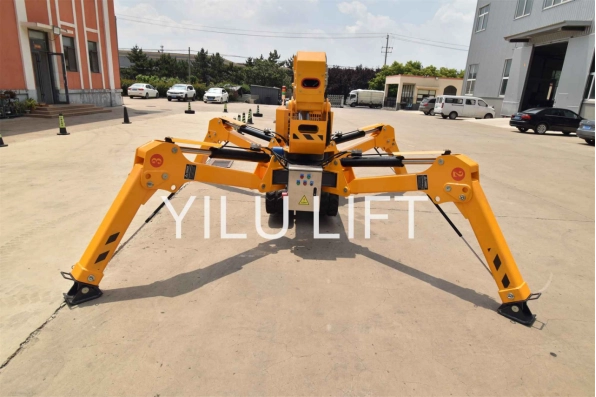
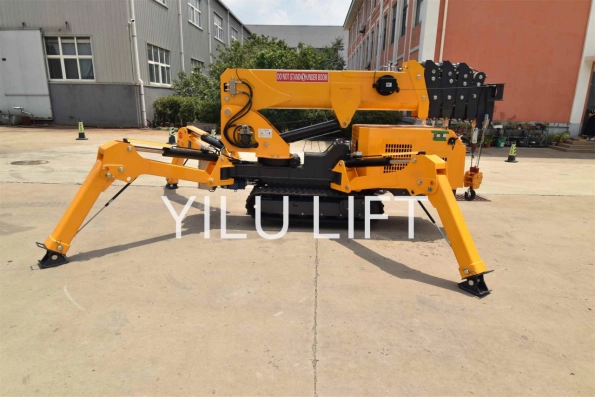
Spider cranes achieve their compact travel size by folding their outriggers. In operation, those supports create the stability base. Some charts apply only with outriggers fully extended, while other machines publish separate ratings for partial extension or restricted slew sectors. Never assume a tight setup keeps the full chart.
Measure the operating footprint, not just folded width. Record obstructions that limit individual legs. Ask whether partial positions are permitted, how the crane senses setup, and which chart applies. If the proposed position is not covered by the model documents, raise it with YILU LIFT and the qualified lift planner before the crane is selected for that job.
Ground bearing is part of capacity planning
The supporting surface must carry reactions at the outriggers and tracks. A floor that supports the machine’s total weight may still be unsuitable for concentrated outrigger loads. Suspended slabs, basements, trenches, recently backfilled ground, utility covers, and soft landscaping deserve attention.
Ground-bearing calculations, mats or cribbing, and slab checks should be prepared by qualified parties. The machine also needs to be level within manufacturer limits. Poor support cannot be corrected by choosing a larger tonnage label.
Compare the Crane Around the Work, Not One Specification
Access dimensions and self-weight can rule out a model
A mini spider crane is often chosen because conventional mobile cranes cannot enter the work area. Compare folded length, width, height, machine weight, track type, turning space, gradeability, and transport method with the route. Door width alone is not enough. Check floor capacity, elevator limits, ramp angle, threshold clearance, and outrigger space.
SOLLEVATORE PER LA TESTA CL3.0 spider crane is listed with a folded size of 3.5 x 0.8 x 1.85 m and a dead weight of 2,700 kg. Its published maximum operating radius is 10.5 m and maximum ground lift is 10.8 m. These figures are useful for early checks on access and reach. Capacity at the planned radius should then be confirmed against the model-specific chart, using the actual load, boom, hook, and outrigger setup.
Power choice should fit the operating environment
An electric spider crane can suit indoor or emissions-sensitive work when the site provides the required supply and cable management. A diesel spider crane offers different mobility and refuelling patterns. Some crawler spider crane configurations combine engine and AC power. Compare noise, ventilation, runtime, starting temperature, site rules, maintenance capability, and local power specification.
Remote control can improve the operator’s view, but it does not add chart capacity. Confirm which functions are remote, how emergency stop and load indication work, and whether the quoted configuration includes the devices described.
Shortlist a YILU LIFT Spider Crane Around the Lift
Model names cover a wide nominal range
SOLLEVATORE PER LA TESTA crawler spider crane range covers nominal classes from 1.5 to 18 tons, with maximum operating radii from 6 to 33 m and maximum ground lift figures from 6.5 to 35 m across the range. It includes compact units and larger construction models. Client terms such as spider crane 3 ton, spider crane 5 ton, small spider crane, or mini crawler spider crane are entry points, not complete specifications.
A quote for a 3 ton mini spider crane and a 5 ton unit may include different boom sections, engines, controls, outriggers, hook arrangements, safety devices, and documents. Normalize those items before comparing totals.
Maximum radius and maximum load should never be paired automatically
A table may show maximum capacity in one row and maximum operating radius in another. Reading them side by side does not mean the machine lifts the maximum load at the maximum radius. Manufacturer charts show how rated load changes with boom length and radius, while notes may include hook-block weight or outrigger conditions.
Shortlist the exact model, working-range information, outrigger condition, hook arrangement, and standard configuration. The spider crane product category helps narrow the family; the lift schedule and site constraints then give YILU LIFT the basis for confirming which model data applies.
Prepare a Capacity-Focused RFQ
Send a lift schedule with verified weight, dimensions, center of gravity, lifting points, pickup height, placement height, maximum working radius, obstacles, and required boom or jib configuration. Add the weight of hook blocks, rigging, vacuum lifters, spreader beams, and other attachments. Include the site plan, access route, folded-size limits, allowable machine weight, operating footprint, ground or slab information, environment, power preference, destination country, and required compliance documents.
Ask YILU LIFT to identify the proposed model and the load-chart cells relevant to the critical lifts. The response should identify outrigger configuration, slew restriction, hook or falls arrangement, attachment deductions, ground-support assumptions, included safety systems, transport dimensions, machine weight, and operating limits.
FAQ
Can a 3 ton spider crane lift 3 tons at full reach?
No. The 3 ton figure normally applies only at a short radius and defined configuration. Capacity falls as radius and boom requirements increase. The model’s load chart gives the allowable value for each approved setup.
What is the difference between lifting height and working radius?
Lifting height is vertical reach to the hook or load. Working radius is the horizontal distance from the crane’s center of rotation to the load line. Both are needed to select a boom configuration and read the correct chart value.
Does fully extending the outriggers always give full capacity?
Full extension commonly provides the widest support base, but capacity still depends on model, boom, radius, slew area, hook arrangement, ground support, and chart notes. Use only the manufacturer’s approved chart.
Should rigging weight be deducted from capacity?
Yes. Chart notes determine how hook-block weight is handled, and the weight of slings, beams, shackles, vacuum lifters, and other below-the-hook equipment must be included in the total load calculation.
Ask for the Chart Behind the Quotation
A spider crane purchase should end with a documented capacity match, not a tonnage guess. Buyers can send YILU LIFT the lift schedule and site constraints to discuss the applicable model, chart, configuration, and quotation. Final selection and operation must follow the approved lift plan, confirmed configuration, site conditions, and destination-market rules.