

Spring-Loaded Pallet Positioner: Will It Suit Your Loading Cycle?
Spring-Loaded Pallet Positioner: Will It Suit Your Loading Cycle?
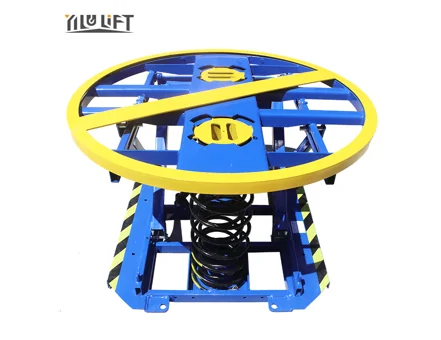
Picking cartons from a full pallet and picking the last few off the bottom are quite different jobs. The goods start high and finish low. A spring-loaded pallet positioner is designed around that changing load, with a rotating platform to bring another side of the pallet towards the worker.
There is a catch worth discussing before choosing one: the springs have to suit the goods. YILU LIFT describes its spring selection in terms of a fully loaded pallet’s weight and height. A maximum weight figure, by itself, leaves out much of the job. What happens between the first carton and the last?
Follow One Pallet from Full to Nearly Empty
Take one of the pallets the station will actually handle. Its loaded weight and height are the starting point. Then follow the unloading sequence. For a station that builds pallets, start with the empty pallet and work towards the finished load instead.
Uniform cartons make the description fairly straightforward. Mixed orders take a little more explaining. Perhaps the lower layers contain dense components and the upper layer holds taller, lighter packs. A single figure for the completed pallet hides that difference. Include the quantities and arrangement of the goods, even if the information is already on a packing sheet.
Keep the pallet, trays and dividers in that description. They remain on the deck after the saleable goods have gone, so the end of the picking cycle isn’t a bare, unloaded platform.
How the operator picks matters. Taking a complete layer off in order is different from reaching into several layers to build mixed orders. A drawing of the finished stack cannot show that sequence. A short description of a normal order can.
What Changes When a Layer Comes Off?
The YILU LIFT spring-loaded pallet positioner uses spring balancing. Matching it to a job means looking at the goods’ height as well as their weight throughout the cycle.
Compare a layer of tall, light cartons with a layer of short, dense parts. Even if the two layers weigh the same, removing them takes away different amounts of stack height. Equal-height layers can present the opposite problem: their weights differ. Matching only the full pallet misses both cases.
That matters at the picking surface. The worker reaches for the goods, not the deck underneath them. With tall parts, the relevant hand position might be quite a distance above the platform. State the task as well as the desired working level when asking about spring matching.
A positioner responding to changes in load cannot be taken to promise an identical picking height for every stack. Ask about a typical daily pallet and any substantially different loads, including lighter ones. Spring selection or adjustment requires the supplier’s applicable guidance; these comparisons aren’t adjustment instructions.
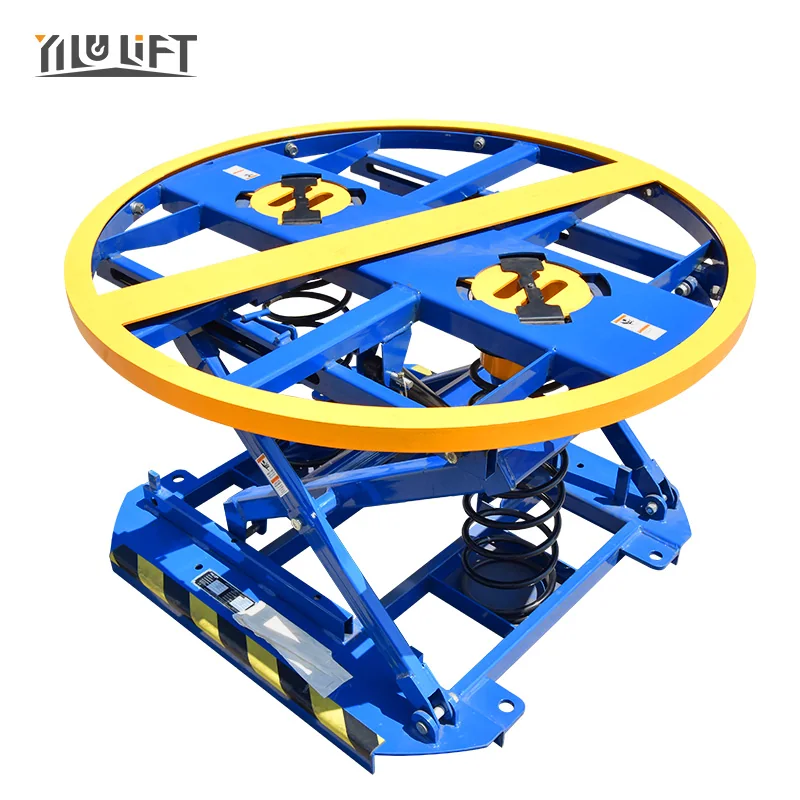
Leave Room for the Goods to Turn
A circular platform looks compact in a product photograph. The loaded pallet may occupy more room, especially with cartons projecting beyond its edges. An overhead sketch showing that larger outline is more useful than a deck diameter alone.
Add the worker’s position, nearby racks and any bench or conveyor receiving the goods. If transfer is always to the left, for example, mark that side and the receiving surface’s height. This makes the discussion about the actual movement of a carton rather than just the movement of the turntable.
Rotation brings a different face of the pallet towards the working side. It doesn’t settle whether an uneven or unstable stack is suitable for turning. Goods concentrated on one side need to be described separately; the total pallet weight gives no account of that arrangement.
How Does the Pallet Get Onto the Station?
The loading method can change the equipment discussion altogether. A forklift placing a pallet and a hand pallet truck approaching from floor level have different access requirements. Include the equipment already used, even where the pallet size is familiar.
For floor-fed loading, the guide to pallet lift tables for hand pallet truck loading deals with the low-profile table and approach question. A spring positioner serves a different part of the handling cycle. It is not automatically a replacement for that table.
With several stopping heights specified by the job, ask about control too. A load-responsive spring arrangement shouldn’t be treated as a powered table that the operator can position at selected levels.
A Useful Starting Point for an Enquiry
YILU LIFT requests the product material, dimensions and weight. For this application, an existing packing sheet can carry much of the detail. The gaps are usually in the handling sequence:
|
Start with |
Add this detail |
|
Full pallet weight and loaded height |
Pallet footprint and what remains at the end |
|
Carton or component size and weight |
Quantity and arrangement in each layer |
|
Picking or loading sequence |
Whether complete layers or mixed orders are handled |
|
Workstation sketch |
Working side, adjacent surfaces and space occupied by the goods |
|
Pallet transfer method |
Equipment used to bring pallets in and take them away |
Estimated figures can stay in an initial enquiry if they’re labelled as estimates. A few notes beside the packing sheet are enough to explain what still needs measuring. Share the sheet when discussing a pallet-positioner application with YILU LIFT, together with a short account of a normal loading cycle.
