
Vacuum Tile Lifter Selection: Surface, Weight, and Installation Checks
Vacuum Tile Lifter Selection: Surface, Weight, and Installation Checks
A vacuum tile lifter should be selected around the actual tile, the contact surface, and the installation movement. Capacity alone is not enough. A unit may have more than enough rated lifting force but still be unsuitable if the pads cannot seal on the finish, the frame does not support the tile correctly, or the available crane cannot place the load at the required angle.
For large ceramic and porcelain pieces, early selection should answer four practical questions: what is being lifted, where the pads can sit, how the tile must turn, and what will carry the lifter. Once those points are clear, YILU LIFT can use the project details to discuss a more relevant suction-cup arrangement, equipment format, and quotation.
Start with the Tile Rather Than the Lifter
Record the real weight and dimensions
Use the heaviest and largest tile in the project, not the average piece. Record length, width, thickness, verified weight, and whether the load is one piece or a pack. The tile’s center of gravity also matters when cut-outs, sinks, openings, or uneven shapes shift the balance away from the geometric center.
Capacity should cover the complete handled load in the intended setup. It should not be treated as permission to lift every tile below the headline number. Pad position, frame reach, tile stiffness, installation angle, and the supporting crane or hoist all affect whether a configuration is workable.
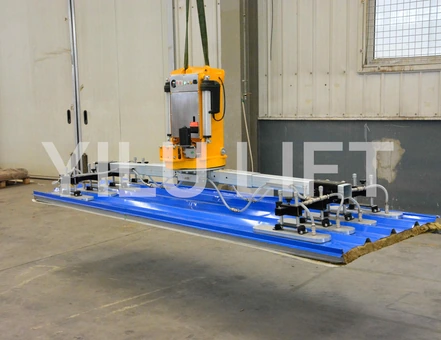
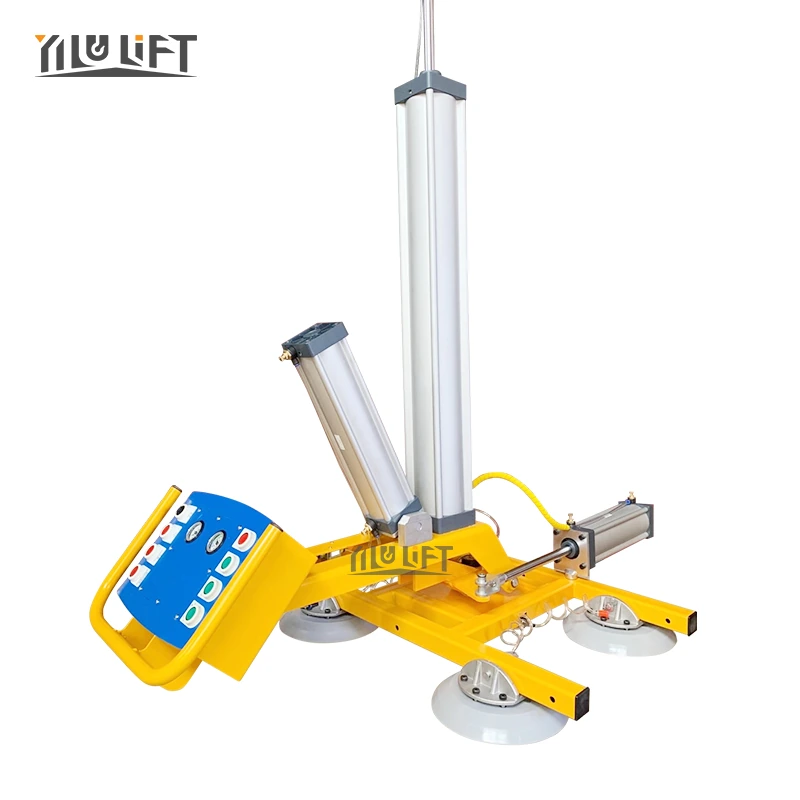
YILU LIFT’s pneumatic vacuum lifter range for glass, tile, and marble provides a useful starting point for suspended handling. YILU LIFT currently offers 200 to 500 kg pneumatic models with different cup quantities and frame arrangements. These ratings support early screening; final selection still depends on the tile, movement direction, and equipment setup.
Map usable pad positions
The frame cannot be judged from overall tile size alone. Mark the areas where a suction cup can make full contact without crossing an edge, relief, joint, hole, protective label, or other interruption. On a narrow or heavily cut tile, the usable contact area may be much smaller than the visible face.
Pad spacing should support the tile without concentrating force in one small zone. Long, thin pieces can flex during pickup or rotation. A buyer should therefore provide a simple drawing or photo with dimensions and any no-contact areas marked. This is usually more useful than sending only a square-metre figure.
Check the Actual Surface Before Choosing Cups
Smooth does not always mean identical
Polished ceramic, glazed tile, porcelain, textured finishes, protective film, dust, moisture, and release agents can behave differently under a suction pad. The relevant question is not simply whether the material is called tile. It is whether the exact face presented to the cup can form and hold a stable seal.
The surface should be clean and suitable for the selected pad before any lift. If the project includes more than one finish, treat each finish as a separate condition. A setup that works on a polished sample should not automatically be assumed to work on a textured or film-covered version.
Use a representative sample when the finish is uncertain
When the contact face is unusual, a representative test piece can reduce guesswork. It should match the production tile in finish, thickness, coating or film, and relevant geometry. The purpose is to check contact and handling behaviour before equipment is committed to the full project, not to replace the applicable operating instructions or site lift plan.
For an enquiry, photographs taken straight on and from the side are helpful. A close-up of the surface is even better when texture is difficult to describe. YILU LIFT can then discuss whether an existing cup arrangement is a reasonable starting point or whether further confirmation is needed.
Set a clear verification point before the first lift
Selection is not complete until the proposed setup has been checked against the real job. Before use, YILU LIFT and the site team should confirm the load in the actual lifting direction, carrier capacity, and operating information for the selected model. A representative tile should verify pad contact, vacuum holding behaviour, and the applicable indication or alarm response under the approved procedure.
Do not continue if the pads cannot maintain a stable seal, a warning or monitoring function does not respond as required, load or attachment details are incomplete, or the actual tile differs from the condition reviewed. Stop the lift and obtain model-specific confirmation rather than treating a successful pickup on another finish as approval for the current load.
Match the Lifter to the Installation Movement
Define pickup and placement orientation
A workshop transfer and a wall installation are different jobs. State whether the tile starts horizontal, vertical, or inclined, and whether it must be tilted, rotated, or turned during the cycle. Also give the final orientation and the clearance available around the placement point.
If a tile must move from a crate to a wall, the equipment needs enough control for both the main lift and the final alignment. Smooth motion matters because a large rigid-looking tile may still be vulnerable to edge contact, sudden movement, or uneven support. Required rotation and tilt functions should be agreed before comparing prices.
Identify the supporting equipment
A suspended vacuum tile lifter depends on another machine for lifting and travel. Tell YILU LIFT whether the project uses an overhead crane, gantry, jib crane, mobile crane, hoist, or another approved carrier. Include the available hook height, lifting capacity, travel path, and connection arrangement.
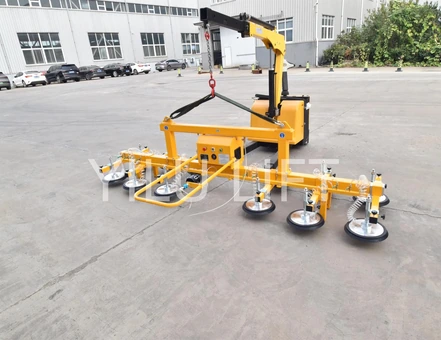
The YILU LIFT suction cups lifter category includes several equipment formats. Comparing them by application is more useful than comparing headline load alone. A pneumatic suspended unit may suit a workstation with an existing air supply and crane, while a mobile powered machine may be more relevant when the equipment must also travel and position the load.
Decide Between Pneumatic and Powered Handling
Pneumatic equipment for an established workstation
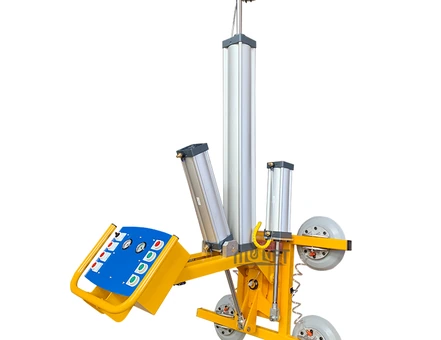
Pneumatic lifters can fit production or installation workflows that already have suitable compressed air and lifting equipment. YILU LIFT’s active pneumatic range runs from 200 to 500 kg. Different models use different cup quantities and frame arrangements, so the tile geometry remains part of the selection.
Before selecting this format, confirm air supply at the point of use, hose routing, the carrier’s available capacity, and the required tilt or rotation. Hoses should not interfere with the tile, workers, or travel path. The suspended equipment and the tile both count toward the load handled by the supporting crane.
Mobile or electrically powered equipment for combined travel and placement
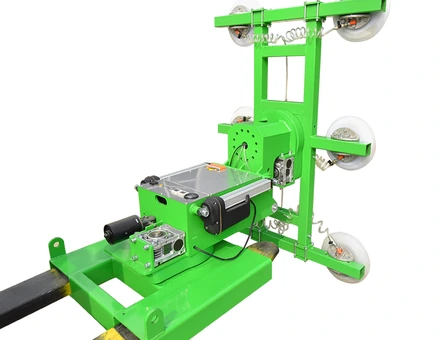
Products described as a tile suction cup or an electric suction cup for tiles can refer to very different equipment layouts. When the job includes moving the tile across a floor as well as lifting it, a mobile powered format may remove the need to coordinate separate handling equipment. The decision then expands beyond suction. Turning space, floor condition, doorway width, approach distance, reach, charging arrangements, and the operator’s view all become part of the selection.
Do not treat a powered machine as automatically better. It is better only when its movement and access match the route. A compact suspended unit can be the simpler answer at a fixed station; a mobile machine can be more useful when the same device must collect, carry, raise, and position the tile.
Walk Through the Route Before Requesting a Quote
Check access and clearances
Measure the narrowest doorway, aisle, lift, turn, and work zone. For suspended equipment, check overhead clearance and crane coverage. For mobile equipment, check floor loading, ramps, thresholds, slopes, and the space needed to turn with the tile attached.
Look at the route with the largest tile in mind. The machine may fit through a doorway when empty but not with a wide panel on the cups. Edge protection, packaging removal, staging space, and the order of installation can change the workable route.
Describe the working cycle
State how many pieces are expected per shift and how far each piece travels. A slow installation sequence may place more value on fine positioning. Repetitive workshop handling may place more value on straightforward pickup, release, and return travel. These details help distinguish a technically possible configuration from one that fits the actual production rhythm.
Common Selection Mistakes
Choosing by capacity only
The largest number does not answer whether the cups fit, whether the tile is adequately supported, or whether the frame can make the required movement. Begin with the load and route, then confirm capacity in that configuration.
Assuming every tile face will seal the same way
Finish, film, dust, texture, and edge details can change contact. Group the project by surface condition and identify any finish that needs a representative check.
Forgetting the carrier and connection
A suspended lifter is part of a handling system. The crane, hoist, hook, attachment, air hose, and working clearance need to be considered together. Sending these details early reduces back-and-forth during selection.
FAQ
Can one vacuum tile lifter handle ceramic, porcelain, glass, and stone?
One machine may be considered for several smooth, non-porous materials, but material names do not prove that every surface is suitable. Weight, finish, usable pad area, flexibility, cup arrangement, and movement must be checked for each application. Share representative samples or close-up photos when the contact face changes.
How much spare capacity should a buyer select?
There is no single percentage that replaces model-specific review. Use verified load weight, include the complete handled arrangement, and confirm the applicable capacity for the intended orientation and equipment setup. Do not choose from the maximum number without checking the actual configuration.
What information helps YILU LIFT recommend a configuration?
Send tile dimensions, maximum weight, surface photos, cut-outs or no-contact zones, pickup and placement orientation, required tilt or rotation, supporting crane or hoist, air or electrical supply, route measurements, and expected working cycle. Also state any site operating or approval requirements that must be met before the first lift. A drawing or marked photo is welcome but does not need to be formal.
Prepare a Useful Tile Lifter Enquiry
A concise enquiry can start with three items: a tile photo or drawing, the maximum size and weight, and a short description of the pickup-to-placement movement. Add surface close-ups, carrier details, route measurements, and required functions when available.
Use the YILU LIFT Send a Message form to share the project conditions and request a suitable equipment discussion and quotation. Clear inputs make it easier to compare the relevant format, cup layout, movement functions, and site requirements without treating unlike machines as direct alternatives.